AI + Media: 2026 Predictions
From pilot to architecture
It’s prediction season once again. Everyone’s doing the annual ritual where we squint at a trendline and declare the future in 10 bullet points. Some of it is thoughtful and a lot of it is just content.
I don’t want to add to the noise, I want to offer my own opinions on what really is the right signals. And so here’s the lens I’m using for 2026: I’m not trying to predict the next model. I’m watching where the work moves.
AI is interesting, but as we have seen, it’s not actually changing the business. The thing that changes a business is where decisions get made, when they get made, and who gets to override them. That’s the real shift. Not the demo, not the prompt, not the benchmark. The operating behavior.
That’s why most of these predictions are not about new capabilities. They’re about defaults. About the parts of the stack that become mandatory. About the places where pilots stop being experiments and start being architecture.
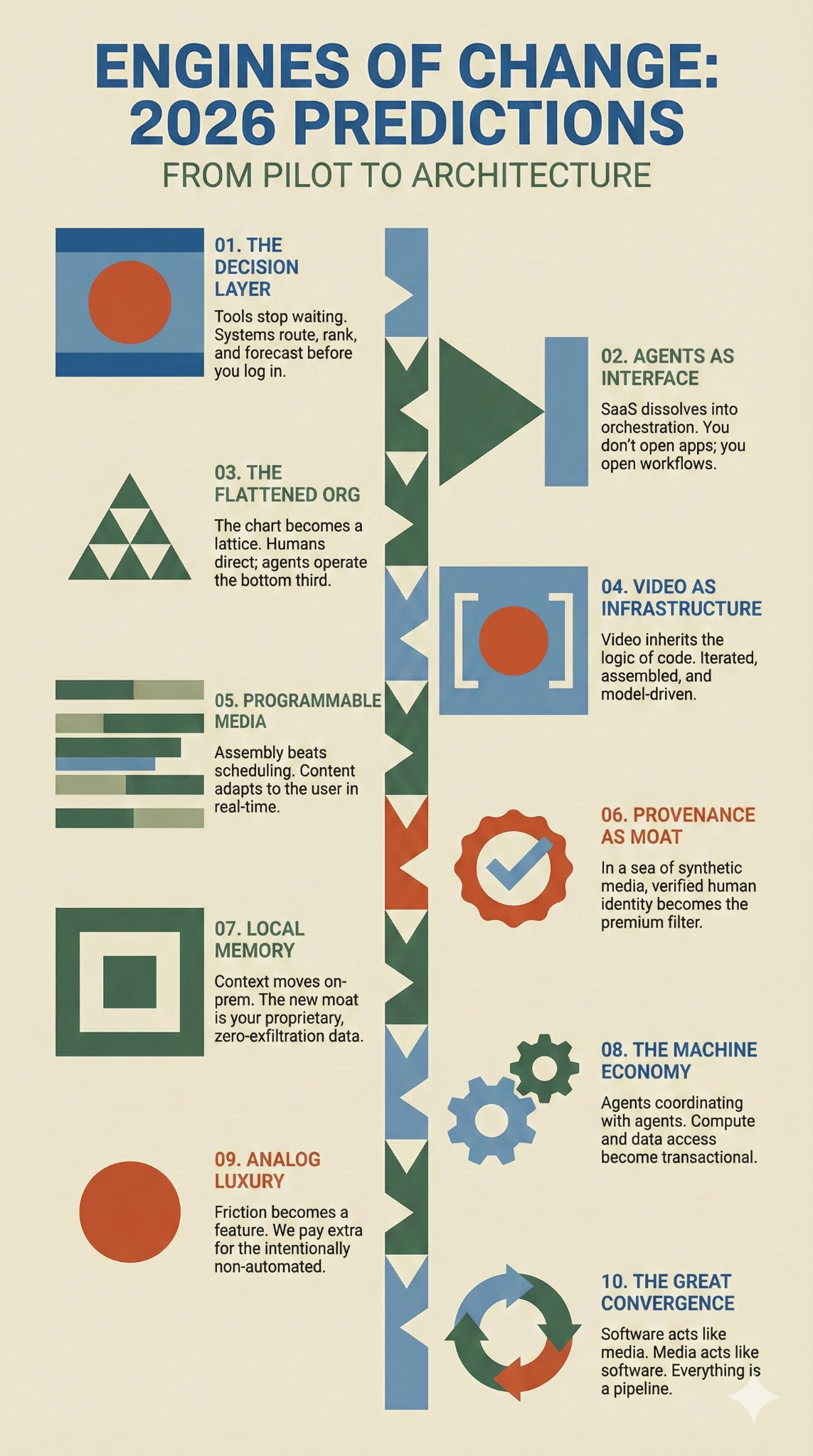
2025 was the year everybody tried something. A few pilots shipped. A few decks got braver than the pipelines behind them. 2026 is when the pilots harden into architecture.
Not because the models suddenly “wake up,” but because the work keeps migrating upstream. Judgment gets cheaper earlier in the chain. Cleanup stays expensive forever. So the defaults move slowly, then all at once.
Here are the signals I’m watching.
01. The Decision Layer
In 2026, the decision shows up before you do.
This is routing, ranking, and risk scoring moving earlier in the workflow. Not as a separate “AI step,” but as the air you breathe. What gets approved, what gets escalated, what gets held back, what gets recommended, what gets shaped into the version that lands in front of a human.
Media teams will feel this first in unglamorous places: rights clearance triage, brand safety, ad suitability, newsroom verification queues, promo selection, highlight routing, content moderation. The system is not making the final call. It is making the first call. That is the shift.
The tell: your job starts to look less like “create” and more like “approve, override, and explain why.”
02. Agents as Interface
2026 is when people stop thinking in apps and start thinking in outcomes.
The interface flattens. You ask for a result, the system negotiates the steps. Under the hood, agents do the boring coordination work across tools you never bothered to integrate.
The blocker is not capability. It is permissions, audit trails, and liability. Enterprises do not deploy “magic,” they deploy accountability. So agents win first where the blast radius is small and the system-of-record is clean: clips, transcripts, metadata, internal search, rough cuts, version comparisons, production paperwork.
Then they move outward.
The tell: “who approved this” becomes a first-class UI element, not a screenshot somebody Slacks after the fact.
03. The Flattened Org
The org chart does not implode. It gets compressed.
The bottom of the ladder changes shape because routine work stops being a reliable training ground. Logging, initial selects, first-pass summaries, first-pass tags, first-pass data pulls. Those tasks do not vanish. They become machine-first, human-checked.
What grows is the accountability layer: people who can evaluate quickly, spot failure modes, escalate correctly, and keep the system honest. Also, a bunch of new coordination work shows up that nobody puts in the press release: QA, policy, toolchain hygiene, vendor management, audit response.
This is a reshaped ladder, not a prophecy about headcount. The bet is simple: fewer layers of handoffs, more emphasis on judgment.
The tell: you hire fewer “doers” by default, and more “reviewers” who can be wrong in public and still sleep at night.
04. Video as Infrastructure
The big change in video is not the look. It is the shape.
Video starts behaving like a system you can recompile. Not just a file you export. More variants. More versions. More parameterization. More “generate a new cut from the same underlying parts.”
This is iteration as the default. Sliders instead of locked decisions. A workflow where “final” is a temporary state you revisit when context changes. Different markets, different audiences, different legal constraints, different runtime slots, different sponsor requirements.
The hard part is not the generation. It is the versioning, provenance, asset management, and metadata discipline that makes infinite branching survivable.
The tell: teams start treating media operations like software engineering. Version control, structured metadata, reproducible outputs, real rollback.
05. Programmable Media
Programmable media wins through packaging before plot.
Most people do not want their prestige drama “personalized” into a different story. They do want the right recap, the right cold open, the right promo, the right highlight structure, the right language and format variant, the right thumbnail and synopsis, the right ad load strategy, the right shoppable overlay when it actually makes sense.
Scheduling gives way to assembly. FAST channels, highlight factories, sports shoulder programming, franchise universes. These are already modular. 2026 makes them more automated, more dynamic, and more measurable.
The tell: you see “content assembly” teams become more central than “schedule” teams, and their tooling starts to look like a build system.
06. Provenance as a Moat
Synthetic media floods every surface. The response is not moral panic. It is paperwork.
Provenance becomes a distribution requirement, not a philosophical stance. Chains of custody, capture metadata, watermarking, C2PA-style attestations, identity scaffolding. Not perfect. Not unspoofable. Just good enough that major platforms, advertisers, and insurers can draw a line.
That favors incumbents and trusted pipes. Not because they are more virtuous, but because they already have compliance muscle and contractual leverage. Provenance is an operational advantage.
The tell: “prove it” becomes a button. If you cannot press it, you do not get premium distribution.
07. Local Memory
Model size stops being the flex. Context becomes the advantage.
The winners are the teams that can build and protect the weird, specific, local knowledge that actually drives outcomes: your archive, your rights history, your brand constraints, your internal taste, your audience quirks, your production patterns, your editorial standards, your legal posture.
Compute will go hybrid. Sensitive context stays closer to the edge or inside tighter trust boundaries. Generic inference stays centralized because it is cheaper and easier to govern. The point is not “edge wins.” The point is “context wins,” and you will architect around it.
The tell: companies invest more in memory, retrieval, and policy layers than they do in chasing the next model benchmark.
08. The Machine Economy
Agents start coordinating with each other the way services coordinate today.
This looks boring at first: service accounts, usage-based billing, token budgets, spend limits, procurement rules, audit logs, policy engines. Then it becomes structural: machines become economic actors inside the org because they have constraints, permissions, and cost profiles.
Once systems can route work between themselves, the “human team managing every handoff” stops being the default model. Humans set policy and review outcomes. Machines execute the handoffs.
The tell: you see internal dashboards tracking agent spend, agent error rates, and agent exception queues the way we track cloud costs today.
09. Analog Luxury
As the routine work gets automated, scarcity moves.
Human-made, human-curated, human-present becomes more valuable because it is no longer assumed. Not because people reject AI outright, but because they start craving signals that something was chosen, not generated.
In media terms, this means more weight on live events, theaters, festivals, community screenings, limited-run drops, “no algorithm” programming blocks, human DJs for culture. “Handmade” becomes a product claim again. Sometimes sincere. Sometimes marketing. Still real.
The tell: platforms and publishers start selling “human curation” like a premium feature, because it is.
10. The Great Convergence
Software begins to behave like media. Media begins to behave like software.
Media teams run pipelines like DevOps. Tech teams ship audience loops like showrunners. Production becomes orchestration. Distribution becomes a product. Creative becomes a system with knobs, guardrails, and telemetry.
The most capable teams will assemble micro-studios out of agents, prompts, templates, and distribution flows. Not as a gimmick. As an operating model.
The tell: “workflow” becomes a competitive advantage people can describe, defend, and hire for.
Closing Note
This is not the year AI takes over. This is the year the defaults ship.
If you work in media, the question is not whether these systems arrive. It is where you let them make decisions for you, and where you insist on keeping a human hand on the wheel.
A useful way to draw that line is simple:
Automate what is repetitive, auditable, and reversible.
Escalate what touches rights, reputation, safety, or truth.
Keep humans on anything that creates precedent, not just output.
Because the real risk in 2026 is not bad generations. It is a quiet policy. A routing rule that becomes “how we do things.” A scoring system that becomes taste. A workflow that becomes authority.
So if you want a concrete plan, start here: map the decisions in your pipeline. Name who owns them. Define what “override” means. Add audit trails before you add more automation. Then ship.
If that sounds boring, congratulation. Boring is how infrastructure wins.
And before we all scatter into holiday mode, thank you for reading, sharing, and arguing with me this year. I’ve got a few more pieces queued up before the calendar flips, but I’m also looking forward to coming back next year and tracking the new defaults as they show up in the news, one shipping decision at a time.


Love this article!
Yes, ... can we all agree that AI isn’t removing people from the equation, but repositioning where human judgment matters most?
Humans set the rules.
Humans review outcomes.
Humans step in when rules aren't enough and common sense is needed.
That balance feels like the real future: machines handling scale and repetition, while humans protect meaning, trust, and accountability. Machines can follow rules, but humans decide what's worth protecting.
Additionally, this aligns with what I'm seeing too.
When machines do routine work, human work stands out more.
“Made by a human” becomes a true selling point.
Priceless!