

Part III ended on a pressure question. If memory becomes the system of record, whoever owns that layer controls what media can become next. The answer was deferred because the outcome is genuinely open. The contestants are real. The stakes are not theoretical. Part IV does not resolve that question. It follows its consequences into terrain the industry has not mapped.
The first three parts of this series traced an infrastructure problem. Context gets lost at every stage of the pipeline. It can persist instead. When it does, the legibility of a catalog becomes its primary asset. That is the capability story. This part is about what the capability produces when it runs without governance: a transformation velocity the industry has no mechanism to account for, and a rights crisis it is not prepared to name.
Transformation Is Now Continuous
Derivatives have always existed. Studios made sequels. Distributors licensed regional cuts. Broadcasters created promotional variants. This was understood as occasional work: a discrete decision, a negotiated agreement, a bounded production event. The human workflow could absorb it because the volume was legible. You could count the decisions.
What changes when context persists is not the existence of derivatives. It is the rate. The finished work is no longer the output. It is the input.
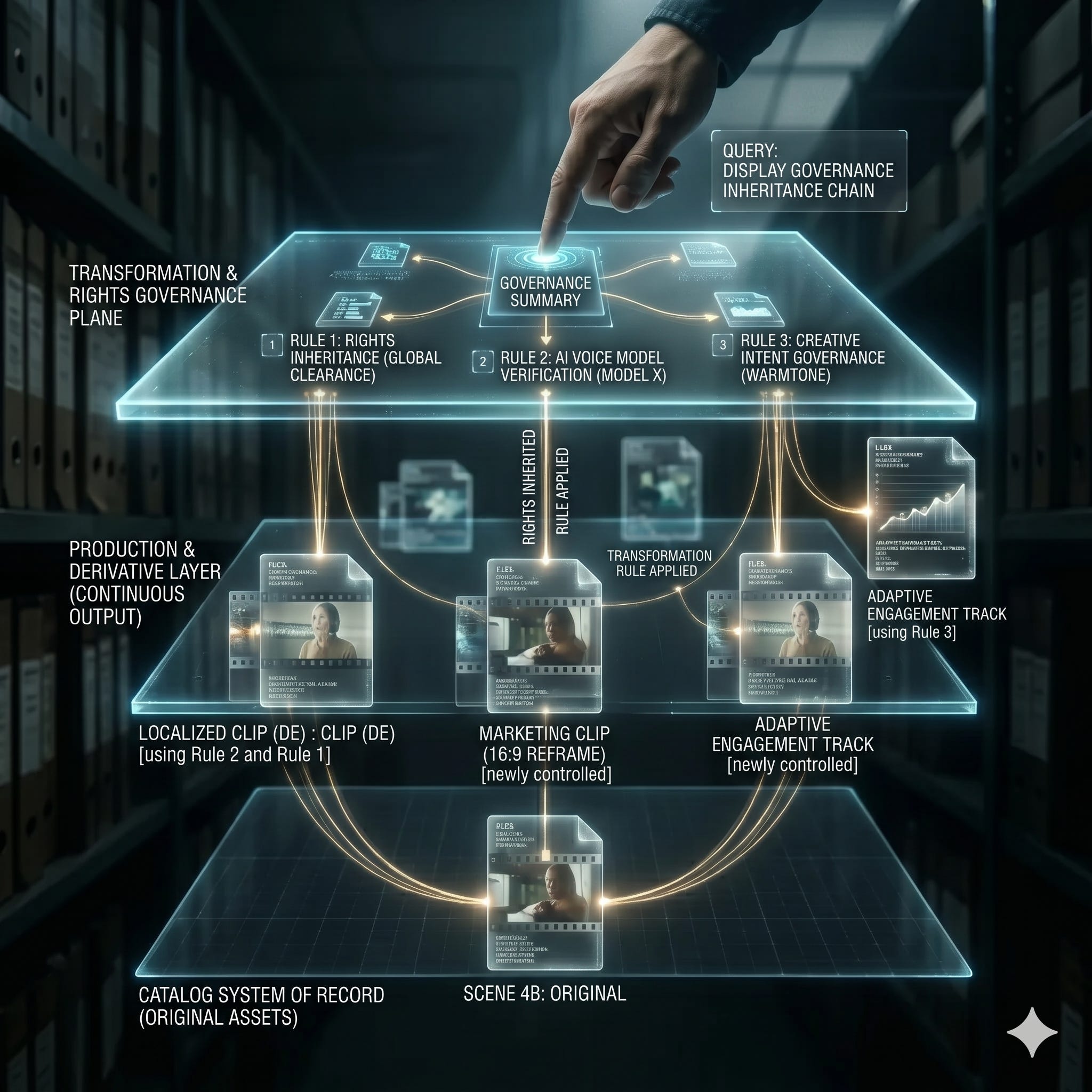
A pipeline operating on structured semantic data does not produce one regional variant. It produces a hundred, automatically, continuously, triggered by parameters the system already understands. Language, platform, device, audience segment, market clearance, content rating, placement window. Each variable the system can read becomes an axis along which the asset can be recomposed without a human decision at every step. The catalog is not a library of things to distribute. It is a library of things to transform.
FAST channels already operate this way, assembling programming from catalog assets in real time based on audience and advertiser signals. Streaming platforms generate platform-specific encodes, alternate audio tracks, and localized metadata at scale. The personalization layer that once applied only to recommendation now reaches into the asset itself. Which cut, which version, which framing, which runtime. The infrastructure for continuous derivative output is not being planned. It is running.
The volume does not feel dramatic because most of it is invisible. Each individual transformation is unremarkable. The aggregate is not.
