


In August we published Agentic AI in Media: Control is the Story, arguing that the story in media technology was control. Not which model wins, but who owns the layer that decides what a system is allowed to do. We built it from two methods that had no reason to agree. Lorenzo ran a corpus of 148 NAB 2026 exhibitor announcements and found that the top word was control, co-occurring most with IP, with AI sixth behind cloud. I walked the floor for five days and heard the same thing in private that the corpus found in public, which was that the marketing was about AI features and the roadmap conversations were about wiring and position in the stack.


We closed by naming four things we would watch for at IBC and promising to publish the verdict either way. The four tests are at the end of Part 1, for anyone who wants them.
Here it is, and it has three parts. The two of us independently arrived at the same conclusion about this market, from different evidence, and neither of us was looking for it. One of us got a significant claim wrong and is correcting it in public. And we agree on where the market is heading while differing on how long it takes to get there. All three of those are more useful to you than a victory lap would have been.
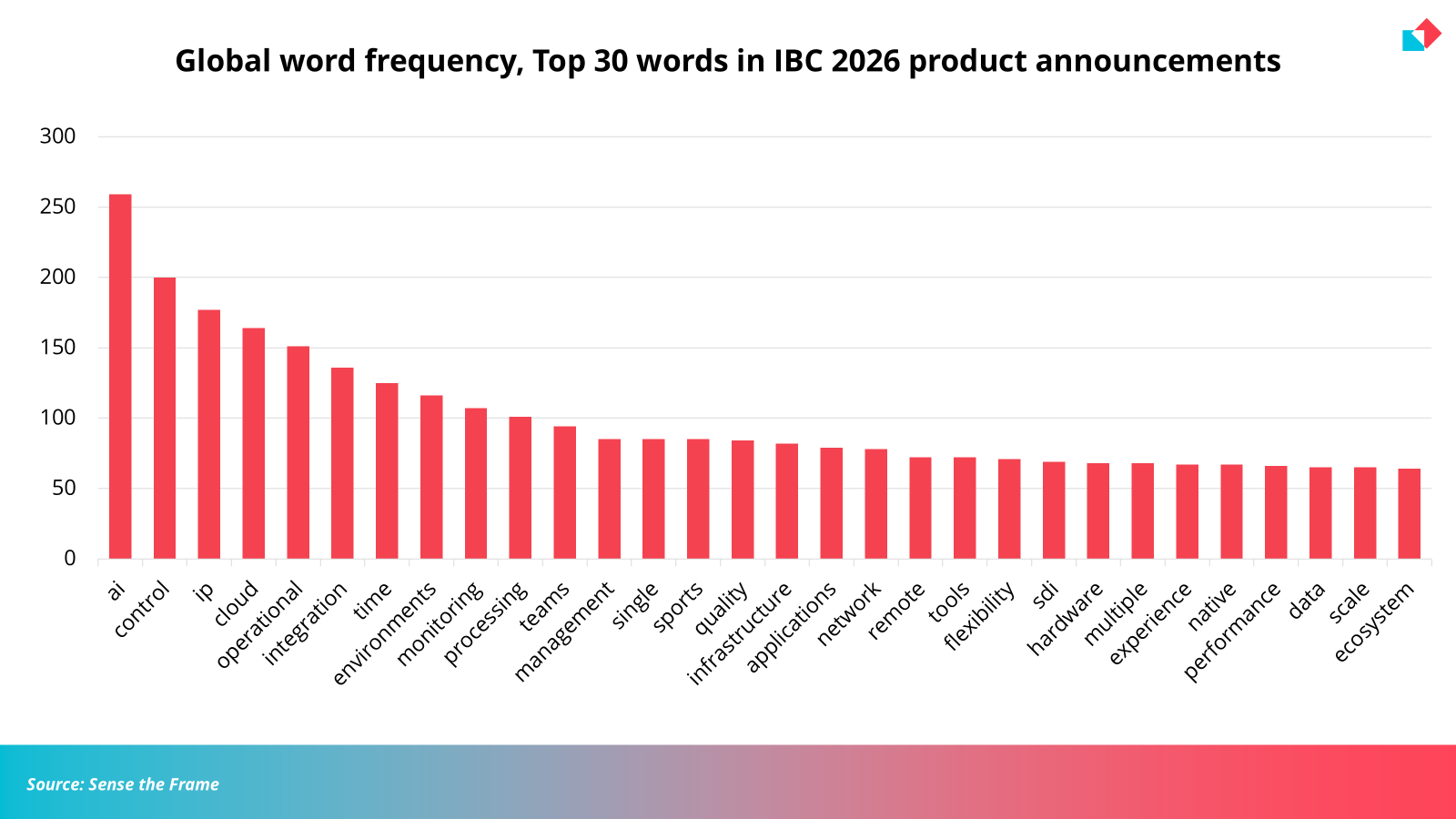
Lorenzo ran the same corpus method on IBC, and the order changed. At NAB, control led and AI came sixth.
I have analysed a corpus of 137 IBC 2026 product announcements, stripped of stopwords and vendor names, and ranked them by raw word frequency. AI leads, as expected, followed by control, IP and cloud. What’s more interesting to me, however, is that words like operational and integration are much higher in this ranking compared to my NAB Show 2026 analysis. That operational cluster suggests vendors are increasingly describing how their products fit existing operations and infrastructure.
The convergence
Lorenzo published his IBC notes on 17 September. The first section is titled Pressure, and the load-bearing sentence is that increasing pressure on media companies has translated into fewer buyers attending IBC, with some major broadcasters not attending at all this year and those who do attend staying for shorter periods.
I published a readout built from a week on the floor. Its first section argues that the pool of buyers is shrinking and that the buyers who remain are cutting the number of suppliers they work with.
We did not coordinate. The pieces went out a day apart. Caretta Research went into the show with the same position, that the industry is contracting, with consolidation removing buying organizations, survivors reducing supplier counts, equipment life being stretched, and the market decline concentrated in large hardware-heavy manufacturers while smaller software-focused vendors grow.
That is three reads and one conclusion. The interesting question at IBC 2026 was not which architecture wins. It was who is left to buy one.
This matters because it changes the test a product has to pass. Working is not sufficient. It has to earn money or take cost out, and it has to do so inside an organization that is deliberately trying to manage fewer relationships. A vendor with an excellent component and no answer to that second part is in trouble regardless of how good the component is.
My readout could only say that IBC publishes totals with no breakdown by role. Lorenzo has the mechanism behind the number.
IBC 2026 visitors were down 6% year-on-year. Even though granular data on buyer attendance is not publicly available, anecdotal evidence points in one direction. DPP’s David Thompson captures it well: consolidation and cost-cutting in the industry has led broadcasters to deprioritize trade show attendance, with some broadcasters like the BBC (as reported by Caretta Research’s Rob Ambrose) stopping all IBC travel, while others sent fewer people for less time. In line with both reports, I found vendor accounts of traffic flows inconsistent.
Aside from the economic conjuncture, there are other trends that are also working against attendance. Trade shows are becoming more regional (i.e., more dependent on local attendance), which means that IBC may have become more dependent on European attendance. The pool of European buyers has a larger share of public broadcasters, a sector facing government-led budget cuts - not just the BBC, France Télévisions has seen a 20% reduction in its budget over the last decade. And this regionalization is happening alongside a rise in local, conference-led, topical events, which means more competition. Moreover, products on the show floor have also increasingly become software defined, which weakens the traditional reasons to attend a trade event.
While we suspect that the number of buyers is down, the number of exhibitors has stayed relatively flat in the last few years, roughly meaning that fewer buyers are more stretched across the same number of vendors.
Where I was wrong
This next part is mine alone.
In the days after the show I drafted a follow-up to Part 1 arguing that the control layer had gone open, that the buy side had organized before the sell side could capture it, and that the margin had therefore moved one story up. I sent that outline to Lorenzo. It was wrong, and the error was basic enough that I want to state it plainly rather than quietly drop it.
I had been reading a vendor technical guide rather than the primary source. The EBU’s Dynamic Media Facility Reference Architecture version 2, published on 15 April, describes six horizontal layers, with Media Exchange as the fourth, sitting between the Container Platform below and Media Functions above. Orchestration, Control, Monitoring and Security are not layers in that model. They are verticals that cut across all six. Orchestration, in the EBU’s own phrasing, creates and destroys resources in each layer, and the Media Exchange layer contains its own control section.
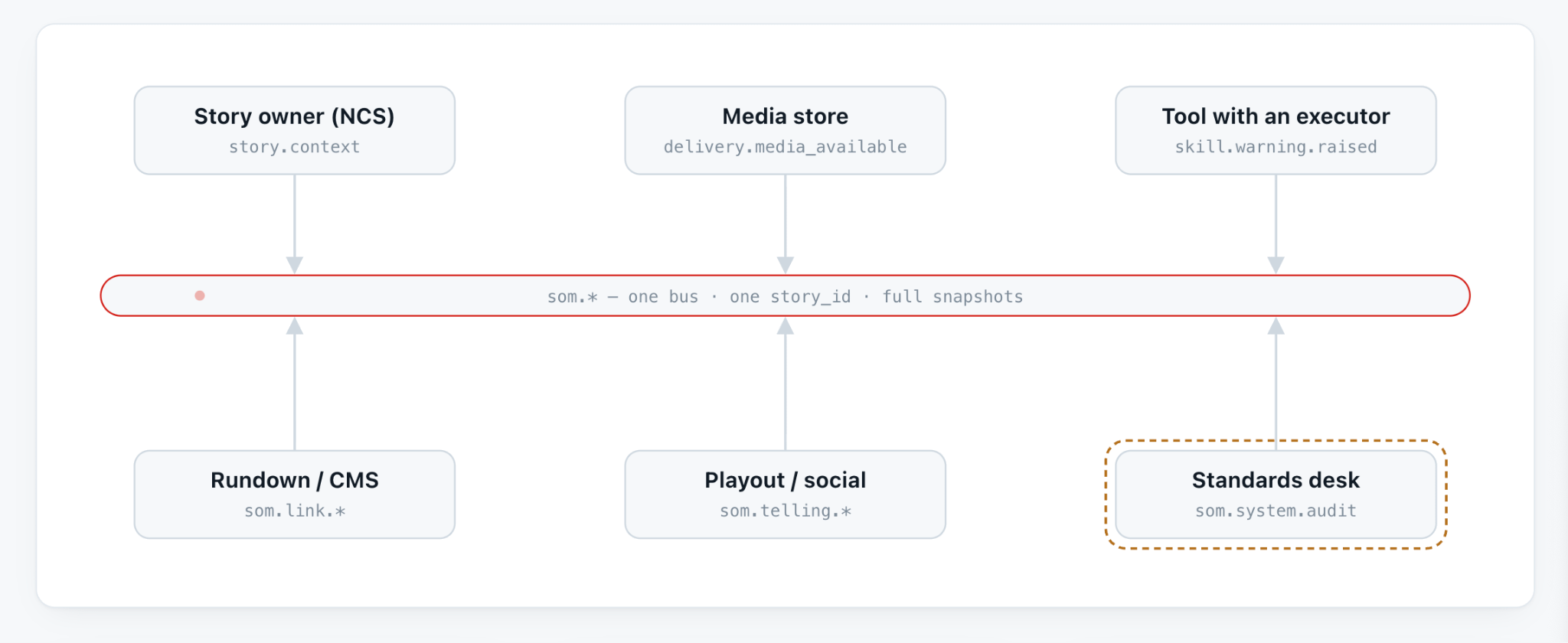
So control is not a layer above the exchange that could go open or stay closed. It runs through the stack, and the EBU wants those interfaces open too, building on NMOS. The Story Object Model says the equivalent thing from its side, which is that nothing sits above the tools, no orchestrator and no central application. Jon Roberts of ITN, who ran the accelerator that produced it, goes a step further. “Control is not a layer here,” he told me. “It turns up at every level: the rights on an asset, the compliance position on a story, who is cleared to publish to which destination, whose judgement lifts a hold.”
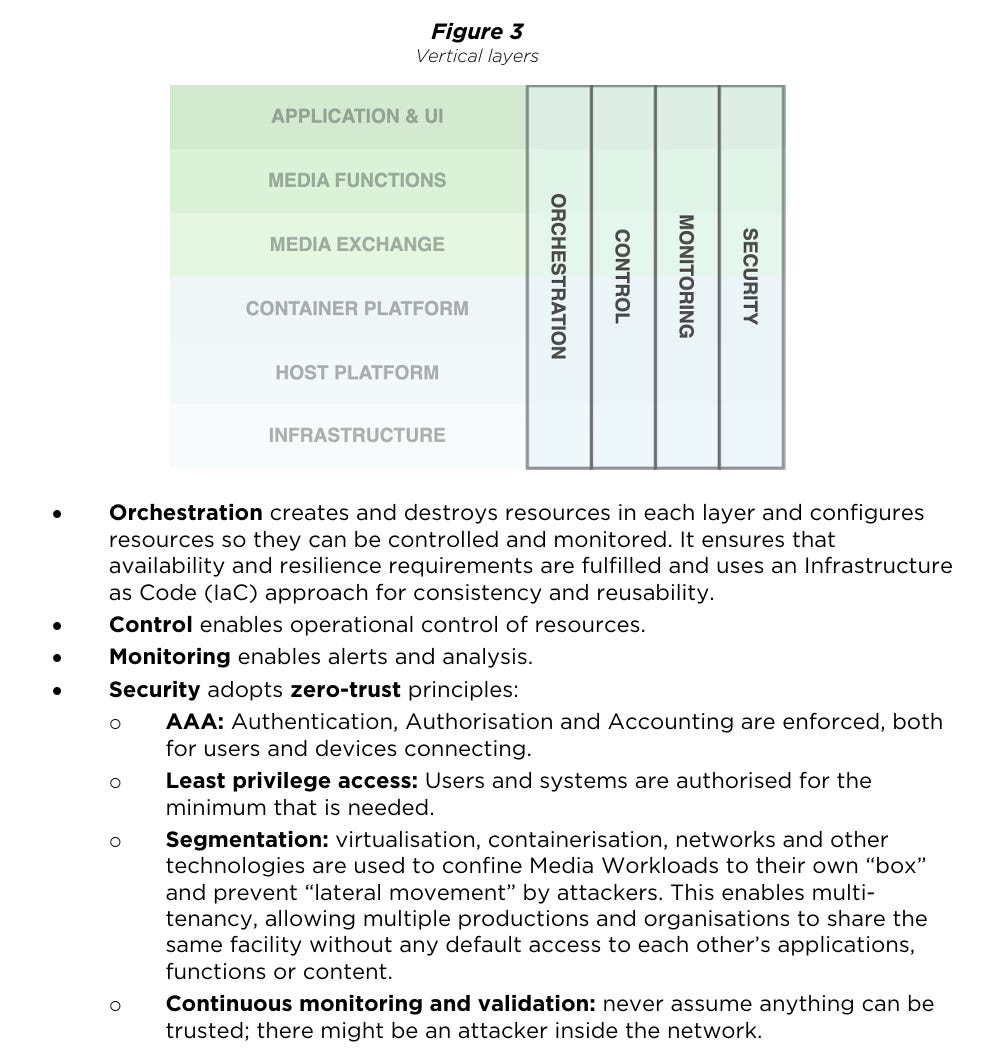
I also had the direction of the economics backwards. The EBU states that the purpose of its six-layer model is to identify interfaces for interoperability “to reduce the risk of vendor lock-in and stimulate a multi-vendor economy.” That is the institution that built the open layer saying its goal is to weaken platform power, not to relocate it upward. I had no evidence against their stated intent, and the same architecture names a possible concentration point below the open layer rather than above it, since where an operator outsources to public cloud, the cloud provider controls the infrastructure layer and may supply the host and container platforms as well.
And I am dropping the scorecard. Our four August watch items were written as things to watch rather than as tests with thresholds. No minimum number of deployments, no definition of coordination, no required standards milestone, no pricing sample, no observation window. Grading them after seeing the evidence is not scoring a prediction, it is writing a favorable interpretation. That is a drafting failure and it is mine. What we can honestly report is below, and the reset at the end sets real thresholds for next time, before the evidence exists.
What actually shipped, described correctly
The most substantial open engineering at IBC 2026 came from two projects that get discussed together and should not be.
The Media eXchange Layer took the top creation award at the Innovation Awards as an open-source Linux Foundation project, with seventeen companies demonstrating it across the floor. IBC 2026 was not its origin, and that is the part most coverage has wrong. Linux Foundation intent was announced in April 2025. Early public SDK code was released in June 2025 and first interoperability was shown at IBC 2025. Version 1.0.0 shipped as a stable production release in early 2026, and the EBU’s stated goal for it was seeing first products for sale between NAB and IBC 2026. Products arrived and multiple vendors exposed the layer at the same show. That is a genuine adoption milestone, and it was a scheduled one. A standards-adjacent infrastructure project hitting the dates it published is rarer in this industry than a turning point would have been.
Be precise about what is stable. The production line is 1.0.x, carrying the Flow API for shared-memory access within a single host. Inter-host flow sharing is implemented in the 1.1 prerelease track, where Beta 1 and the Release Candidate are complete while the final release is not, and the Fabric API documentation remains marked as to be confirmed. When a vendor tells you cross-host is production-ready in their product, that is a claim about their own validation and support commitment rather than about upstream stability, and it should be evaluated on its own terms.
The Story Object Model published version 1.0 on 12 September, at the show, under Apache 2.0 for the schemas, tools and skills and CC BY 4.0 for the specification prose. Fourteen champion organizations, and they are not all broadcasters. The list spans news agencies and newspapers including AP, Reuters and The Washington Post, broadcasters including the BBC, ITV, Sky, Channel 4, Al Jazeera, NBCUniversal and Scripps, and standards and industry bodies including the EBU, SMPTE and the Global Creative and Security Community. It is days old, its reference implementation and integration guide are not in 1.0, and the accompanying skill library sits at 0.2.2 with its skills marked draft. It is not comparable to MXL’s maturity and the two should not be cited in the same breath as evidence of the same thing.
The consequential decision sits beside the schema. The consortium also published a format for newsroom rules and ten reference Skills, and I asked the authors why. Alex Bassett of NBCUniversal answered for the team. A Skill is a document, not a program. It is a newsroom rule written so a machine can check it. The vendor’s tool raises the flag, a person clears it, and the Skill never changes content or acts on its own. They put the format in the commons because a schema without a shared rule format is only a wire format, and because the rulebook was the most valuable thing any single participant could have kept, which made it the place capture would have started. In his words, they “gave away the grammar for writing a newsroom’s rules down and kept our hands off the sentences.” Jon Roberts, speaking for himself rather than the consortium, puts the principle underneath it in six words: “Standardise beneath the intelligence, compete above it.” Below that line sit the context data flow, its junctions to the standards either side of it, the shape of the rule book and the audit trail that travels with all of it. Tooling, models, agents, workflow and the final mile stay above it, where vendors and newsrooms are meant to compete. Morag McIntosh, who conceived the model with Alex & Jon, leads the strand the coverage has ignored: Story Archaeology, which takes one real story after transmission and traces how its context actually moved between the people and systems that handled it.
That is the one part of my first draft worth keeping, stated properly by the people who made the call. It is a statement of intent. Whether it held is what the second NAB 2027 test below will measure.
The adoption ladder
“Adoption” is doing too much work in the coverage. Five rungs can be told apart, and putting a vendor claim on one makes the conversation specific.
One, the code is stable. Reached at 1.0.x for the Flow API.
Two, vendors are shipping implementations. Reached at the ecosystem level. Whether a specific named product is generally available rather than in preview, beta or booth integration has to be asked product by product.
Three, multi-vendor interoperability is demonstrated. Reached repeatedly.
Four, a customer has run it in a real workflow. Reached narrowly. CBC/Radio-Canada ran selected Milano Cortina workflows on it, which the EBU describes as a proof of concept.
Five, mixed-vendor continuous production. We found no publicly documented case. Operators frequently keep production architecture private, so that is a statement about the public record rather than about what exists.
The Innovation Award citation reads “deployed by CBC/Radio-Canada.” IBC’s awards recognize completed projects in real working environments, so the word is defensible on its own terms. Nobody overstated anything. The problem is that “deployed” no longer tells a buyer which of rungs two through five they are being offered.
One counterexample belongs here rather than in a footnote. SVT’s Neo platform won the EBU Technology and Innovation Award this year after delivering more than eight hundred hours across ten parallel environments at the same Winter Games, and Neo is not documented as an MXL implementation. Software-defined production at Olympic scale does not require this layer.
Same destination, different clocks
We agree on where this ends up. We differ on how long it takes to get there, and we are going to leave that open.
My position is that the direction of travel is openness, and that the open question is what openness is for.
Here is the paradox at the center of the whole show. Open interfaces widen the set of suppliers a broadcaster could technically substitute into. Supplier rationalization narrows the set it is actually prepared to manage. The same buyer can push both at once, for the same reason, which is lower integration cost. For a vendor that changes what has to be proven. Interoperability gets you considered. Staying on a list that is being deliberately shortened is a separate test, and it is the one most vendors at IBC were not preparing for.
So the question is whether openness is being adopted to preserve substitution options, or to make a deliberately shorter list cheaper to live with. Nothing on the floor settled it.
Lorenzo’s position is that the supply side is answering it in the short term, and answering it toward consolidation. AI makes point solutions easier to reproduce, so vendors are stacking features together to make their products stickier and harder to substitute, and the pendulum is swinging from point solutions toward end-to-end platforms, through consolidation and through partnership, with some equilibrium likely rather than a full swing.
Those readings differ more on timing than on direction, and it is worth being honest about which evidence each rests on. Mine is a demand-side read from a week of buyer conversations plus the published architecture of the open projects. Lorenzo’s is a supply-side read from vendor announcements and vendor conversations. It is entirely possible that both are accurate about the half of the market each of us looked at, and that the interesting thing at NAB 2027 is which clock was right.
If the short-term tilt lasts, then all of this open engineering is how a smaller set of strategic vendors becomes easier to tolerate, and the practical beneficiaries are whoever survives the cut. If the swing back comes sooner, competition intensifies wherever those interfaces reach, though open interfaces remove only one barrier among several and certification, enterprise agreements, support dependencies, data gravity and operational familiarity can each keep a market concentrated anyway.
Here is Lorenzo’s side, in his words.
I see the journey towards equilibrium playing out from two sides.
Vendors are (rightly) worried about AI replicating point capabilities, particularly as a growing number of buyers increases investment in building technology in-house. To make their products more essential, vendors are taking one of two main routes. Some are going end-to-end, stacking features into platforms that also provide a control layer across them - let’s call this the closed front. Others are staying in the best-of-breed camp but building deeper connections with other vendors through partnerships, frameworks and interoperability initiatives - let’s call this the open front.
The difference boils down to ownership, but in an industry increasingly under pressure from cost, complexity and risk, buyers will expect end-to-end integration regardless of who owns the components. Failure to deliver it may push buyers towards the closed front even when they’d prefer best-of-breed solutions.
In the short-term, I expect buying behaviour to tilt towards the closed front, as vendors scramble to organize themselves through deeper collaboration that emulates the workings of end-to-end platforms. In the longer term, I expect a shift back towards the open front, particularly as some buyers may also retreat from their own build efforts.
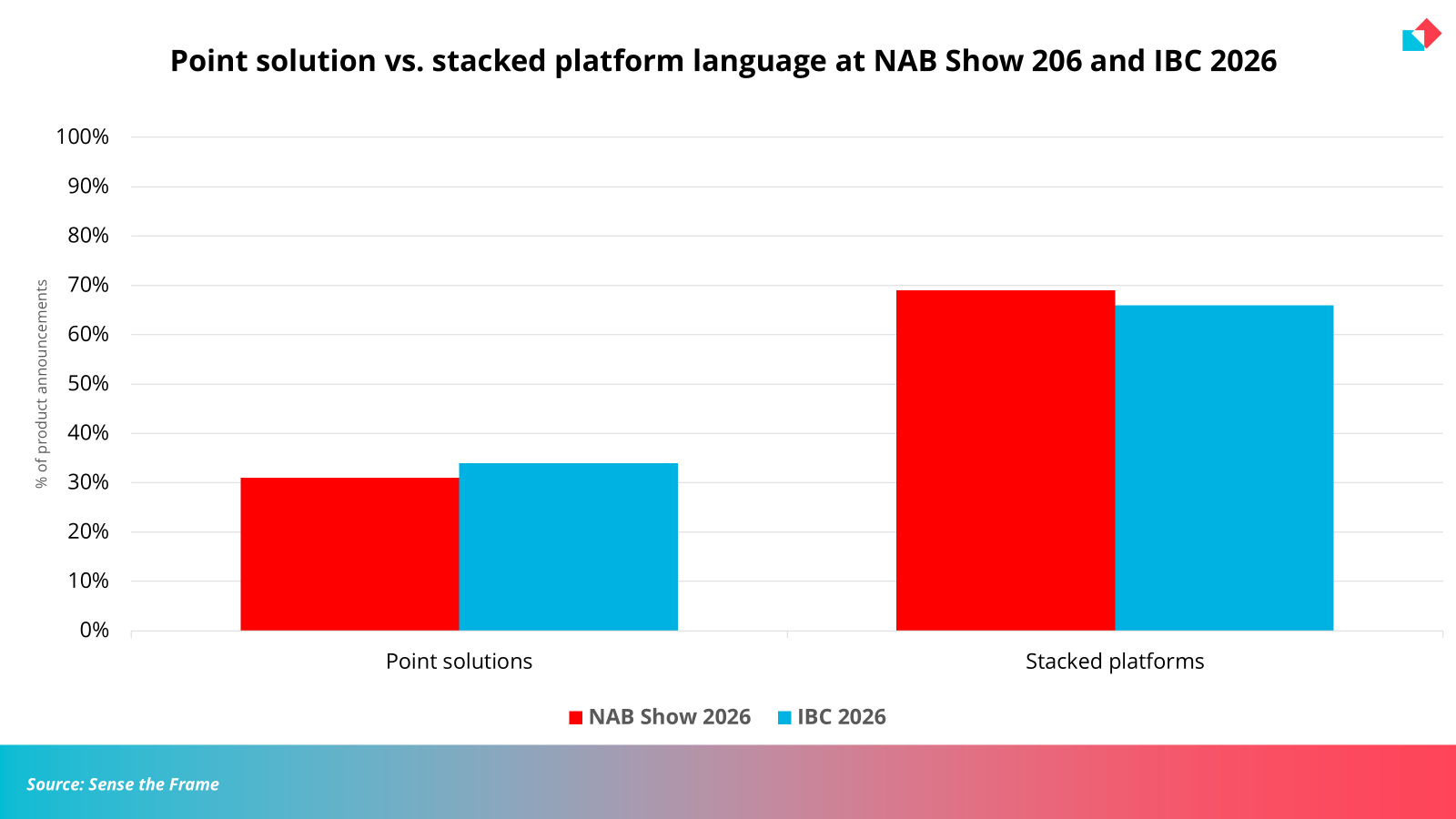
About two-thirds of product announcements at both NAB Show 2026 and IBC 2026 used stacked platform language. This percentage slightly declined at IBC 2026, but too little to draw conclusions about the direction of travel.
What the buyers actually said
Agentic AI was, in my experience of the floor, the most repeated pitch of the show and among the thinnest evidence. Several vendors arrived with agent-facing control surfaces over Model Context Protocol, and governance language recurred across them. Each of those is an announcement or a demonstration. None is a documented buyer deployment. Lorenzo’s corpus adds a telling detail. Eleven of the twelve agentic announcements he tracked at IBC used orchestration language. That is the layer Jon Roberts would least want standardised. He holds that view more loosely than the rest of his argument, and says nobody can yet read where orchestration settles, but writing a standard into the middle of something moving that fast “looks like a poor bet.”
I went in expecting to write that operators are short of engineers. My coded sample says otherwise, and the difference matters commercially.
Of nine distinct operator and rights-holder organizations I spoke with across the week, four raised engineering capacity as a constraint. None of the four described a headcount shortage to be solved by replacing people. What they described was constrained access to the capacity they already have. One network news division had reorganized engineering into skill silos and now generates excessive ticketing for any task that crosses them. One broadcaster’s editorial teams are blocked from experimenting with new formats because standing up resources requires a full engineering team, where in the SDI era they could just use the studio. One league’s production operation runs on roughly twenty engineers, about ten of them key, with the knowledge concentrated in a few senior people. One European operator described the patching and maintenance burden of self-built systems.
Their remedies followed that diagnosis. Self-service provisioning to bypass the ticket queue. Knowledge transfer from senior engineers to the wider team. Interfaces that let existing control-room operators describe what they want in plain language. A supported product to buy instead of a system to maintain. Every one of those augments a fixed engineering base. The league was explicit that adoption among its own engineers is a bigger hurdle than the technology.
In the one conversation where an industry-wide shortage of cloud and AI engineers was stated outright, the speaker was a vendor. The two operators in that room described silos and queues.
Nine organizations is a theme rather than a market, and people who spend forty minutes discussing architecture with me at a trade show are disproportionately people currently changing their architecture. With that said, the commercial implication is sharper than the shortage story. These operators are not buying replacements for engineers. They are trying to get more out of the ones they have and to let non-engineers act without a ticket. A product framed as headcount reduction is answering a question they did not ask.
Business models under pressure
Lorenzo on what the pressure did to how vendors sell.
The pressure on media technology budgets was visible in how vendors are restructuring their business models. This is a consequence of changing demand patterns, which, aside from cost-cutting, are moving in two major directions, largely dictated by risk-reduction: less commitment and more predictability.
When it comes to commitment, some vendors such as Calrec and Nugen Audio introduced shorter-term licensing options. Others like Amagi positioned their products as zero-CAPEX alternatives. Broadly, more vendors are lowering the barriers to entry because buyers are refusing long-term lock-in, particularly due to AI compressing development cycles.
The predictability side of the equation is more complicated, and in some ways cuts against the commitment argument. For example, Suitest introduced flat-rate pricing alongside its existing usage-based model, giving buyers a more predictable fixed cost option. And cloud repatriation fits the same pattern. Some vendors at IBC were positioning on-prem and hybrid deployments as a commercial advantage.
These moves from vendors highlight that buying patterns sit on a spectrum, particularly at a time of pressure like this one, and it is important for vendors to provide different models and entry points to fit different types of buyers.
That is also the honest verdict on the last of our August watch items. We said we would look for pricing that bills like infrastructure. It did not appear. What appeared was a move toward less commitment, and it fits the buyer squeeze better than our prediction did.
On the buy-side, the most underdiscussed trend at the show, relative to its importance, was in-house builds. There is rising evidence that media companies, particularly in some areas such as Northern Europe, are increasing investment in in-house build capabilities. Recent DPP research points in that direction.
This is a threat to the supply-side of media technology, and another pendulum shift. Some history can help here. The sector’s propensity to build technology in-house increased between 2015 and 2020, driven by the move to direct-to-consumer platforms. The pandemic (and a few build failures) brought cost discipline back, pushing the pendulum towards buy through to around 2025. Now, build is back, propelled by the rapid diffusion of vibe-coding technology.
I remember studying this trend before 2020, when a broadcaster told me their build investment was focused on two main areas: building connections between tools and customizing interfaces. Today, their efforts may be focused on the latter, while the vendors build the backend, and enable the connections through deeper partnerships.
Partnerships
Lorenzo and I reached this one independently, from opposite ends. Mine came from the buyer side. A component vendor needs an answer to how it helps a customer manage fewer relationships, and that answer often runs through an OEM, a marketplace, a cloud platform or an integrator, so the component arrives without a new contract attached. Lorenzo’s came from the vendors.
As I said in my IBC 2026 notes, I didn’t expect that partnerships would be such an important theme at the show, but they were. The industry has talked about this for years, but often only as a decoration, not real intent. This year was different, and since publishing my notes I have seen many others commenting on the same thing.
What were the drivers of this trend? Surely, lower buyer attendance led to more vendor-to-vendor conversations on the floor. But, more importantly, vendors are realizing that they can’t do everything themselves. This requires a mental shift from “I am the best at X” to “I can work with Y and Z to deliver X.” Some vendors made that shift, but others were still in aggressive pitch mode. Mentality is not easy to change.
In the future, I think trade shows may become platforms to discuss and showcase vendor connections more formally. For example, if two or more vendors have built a solution that is reproducible and applicable across customers, they can turn that into a published framework the market can evaluate, adopt and reconfigure. That is where the mental shift becomes hardest: accepting that you will not always be picked and being fine with it.
Even vendors more oriented towards end-to-end are recognizing the value of formalizing partner relationships. The Accedo and MediaKind joint streaming solution is a good example of this. It brings the evidence of a buyer already using it and proposes the same model to the rest of the marketplace.
What agents are allowed to touch
Security is not a gap in this industry’s thinking. The EBU architecture carries Security as a vertical across all six layers, with zero-trust principles, authentication, authorization and accounting, least privilege and segmentation. IBC made security, authenticity and provenance a conference theme in its own right. The vendors exposing agent interfaces are not silent on authorization either, with permissions inherited from existing rights controls and human oversight stated as design intent.
The narrower question is what none of the published material answers. When playout, routing, ad sales and system configuration are exposed to agents over a documented protocol, what is the identity model for the agent as distinct from the user it acts for? Who audits the supply chain of the skills and tools it loads? What does least privilege mean for something whose next action is generated rather than configured?
Lorenzo’s framing is that a conversation about agentic AI ends up being a conversation about what agents are allowed to touch, and the Hugging Face attack is the reason a buyer should treat that as urgent rather than theoretical.
Lorenzo’s corpus puts a number on it.
Security and governance language appeared in 36% of the IBC sample, up from 30% in the NAB Show 2026 measurement. And that growth ran alongside the rise in agentic and MCP language at IBC 2026, suggesting that vendors may be starting to connect the two conversations. Half of the agentic-related announcements tracked at IBC 2026 also used security language.
The security conversation is crucially linked to the point vs. end-to-end debate. More components generally mean more attack surfaces, which is something not to disregard in the era of AI cyberattacks. Therefore, security architecture should become an essential element of any partnership discussion.
The security conversation is part of a larger conversation about trust. AI is eroding our confidence in what is real, which makes proofs of authenticity more valuable than ever. This applies to different areas, from C2PA provenance standards to vendors and buyers discussing their technology roadmaps in person.
Consolidation, on hold
Consolidation does two things to a vendor at once. It shrinks the pool of buyers, and it is supposed to create the integration projects that replace some of that lost demand. This year the first happened on schedule and the second got stuck in court.
Lorenzo expected industry pressure to produce vendor M&A near the show and it did not arrive. On the buyer side the consolidation is real and it is stuck. Paramount Skydance’s proposed acquisition of Warner Bros. Discovery has not closed. Twelve state attorneys general sued to block it in July, a federal judge granted a temporary restraining order, Paramount agreed to a no-close and no-integration stipulation while the litigation proceeds, and an antitrust trial is set for March 2027. Nexstar’s acquisition of TEGNA did close, on 19 March 2026, at $6.2 billion with six station divestitures required, and an April preliminary injunction prohibits further integration subject to certain exceptions while an appeal proceeds. RTL’s acquisition of Sky Deutschland closed with a publicly stated annual synergy target.
So buyer-side consolidation is happening and litigated, while vendor-side consolidation is expected and absent. The rationalization of duplicated systems that consolidated companies typically pursue, and the cost takeout that justifies the deal multiple, keeps being deferred. If you sell into broadcast groups, the buyer-pool contraction is real and the specific integration projects you may be forecasting against are sitting in court.
The reset for NAB 2027
Three falsifiable items and one watch item, written before the evidence exists, with thresholds this time. Where a test depends on something becoming public, it says so, because operators keep production architecture private and a test that cannot see past that should not pretend otherwise.
One. Public proof that MXL reaches the top adoption rung. A publicly documented deployment in which media functions from at least two different vendors exchange live media over MXL in continuous operation for thirty consecutive days or more, with the operator named. Thirty days exceeds any single event and requires surviving a maintenance window. Disconfirmed, as a claim about the public record rather than about reality, if by NAB 2027 no such case has been published while at least three further vendors have announced implementations.
Two. A SOM implementation outside the consortium. At least one production newsroom publicly identified as publishing or consuming SOM 1.0 traffic where that organization is neither a champion nor a listed participant in the Smart Stories project. Disconfirmed if all publicly identified implementations twelve months on are consortium members. We will also record whether SOM has a permanent home by then. Jon Roberts says the repository is where 1.0 lives today and not where it settles, that a neutral home is being worked on, and that it should not be handed to any single organization, including the ones that built it.
Three. The pendulum. This is the timing question, made testable. Lorenzo coded every product announcement at both shows as point solution or stacked platform, and about two-thirds used stacked platform language at NAB 2026 and again at IBC 2026. The five-point band is a judgment we are making now about what counts as a real move. It is not derived statistically. If that share rises by five points or more by NAB 2027, the short-term tilt toward end-to-end is holding. If it falls by five points or more while open interchange adoption rises, the swing back has started. If it stays within five points of two-thirds, neither clock has moved, and we will say so.
And a watch item rather than a test. The switching cost gets published once. One named operator running an MXL-based workflow reporting what it cost to replace a media function with a different vendor’s. One case cannot establish whether open interchange reduces lock-in across the industry. It would establish that substitution happens in practice and give the first public data point on its cost. It sits outside the falsifiable three because its absence means the question is untested rather than answered.
Andy Beach is Chief Alchemist at Alchemy Creations and writes Engines of Change. The full IBC 2026 readout this piece draws on is available to Alchemy readers.
Lorenzo Zanni is an independent media technology analyst and founder of Sense the Frame, a data-driven newsletter tracking what is happening at the intersection of media, technology and storytelling. His full IBC 2026 notes are here.
Disclosure. Andy Beach is interim CTO of Fukui Labs and of Secret Level, a venture partner at Hallstone Ventures, and an advisor to swXtch.io, V-Nova and SMPTE among others. SMPTE is a champion of the Story Object Model. No client, advisee or sponsor is cited as evidence in this piece.