

When Interfaces Become Policy
There is a moment in every technological shift when governance stops looking like government.
You see it the first time a system adjusts your words for you. Apple Intelligence smooths your message into something friendlier than you intended. A note written in frustration arrives as diplomacy. Not because you chose restraint, but because the interface chose it for you.
Or look at what surfaced in the DOJ filings around TikTok’s internal mechanics. Semantic steering, they called it. Not outright censorship. Just small directional nudges: a tilt in search, a shift in what loads into the For You feed, a subtle change in which interpretations get reinforced. The point is not that a platform invents a lie. The point is that it can make one version of reality cheaper to reach than the others.
Meta whistleblowers described the same pattern. Algorithmic prioritization used as leverage. Not by altering what was said, but by altering the order in which it appeared. Ranking choices disguised as a neutral technical process, even when those choices have clear political consequences.
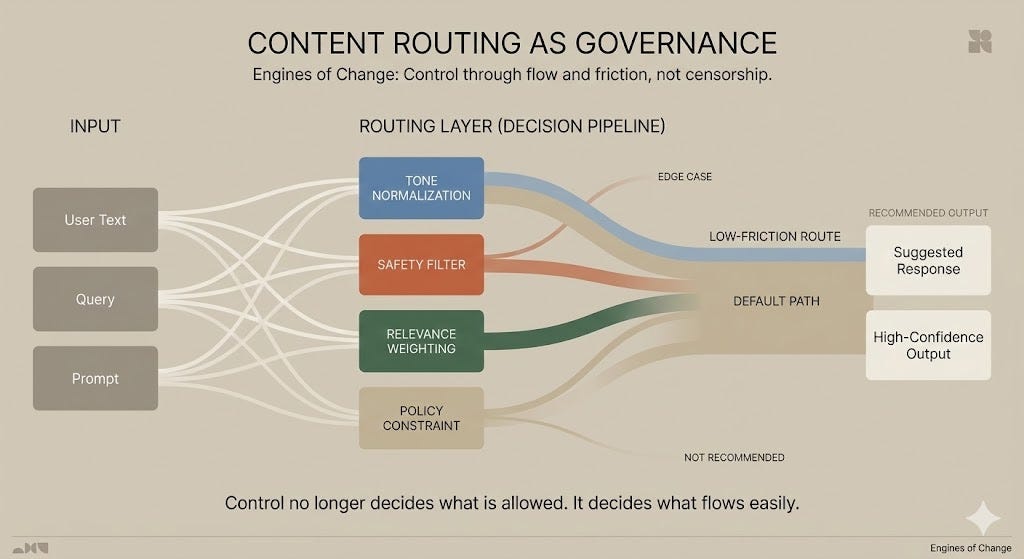
Even large models are drifting into this territory. Refusal behavior is starting to act like governance. As frontier labs deepen relationships with defense and security agencies, what the system will and will not assist with becomes part of a broader permission structure. What began as “safety” and “responsibility” in a product sense can quickly become a boundary on public speech in practice.
This is the threshold where power stops traveling primarily through institutions and starts traveling through interfaces. Defaults become political. Product choices become behavioral rails. A worldview moves from belief into system behavior, and because it ships as software, it scales faster than public debate can react.
The Control Layer is not where freedom disappears. It is where you forget when you last exercised it.
If you want the rest of this essay, subscribe to Engines of Change. The paid version walks through the deeper mechanics of how founder logic becomes behavior, how behavior becomes quiet governance, and why this sets the stage for the final piece in the series.
