

David Sugg has spent 26 years building and operating media supply chains at major studios. He's led large technology programs, managed teams of hundreds, and learned most of what matters by being in the room when things went wrong. He now consults on technology implementations, supply chain strategy, and operations, with a particular focus on how technology actually performs in production environments.
On the surface, a model does not look like a supplier, it looks like software. It is licensed, it has an API, and it sits in the stack next to the transcoder and the asset management system. But what makes something a supplier is not how it is purchased. A supplier is an outside party whose work goes into your deliverable, on terms the supplier controls. The test turns on what the work is, not on what the technology is. The same model is software when it summarizes your ticket queue and a supplier when its output is deliverable subtitles or dubbing. Software is bought against a specification. You know what it is supposed to do, and when it changes there should be a version and a note saying what changed, even when the change was not your idea. Unlike true software, a model can produce the creative work product itself, a translation, a QC decision, a first-pass conform, and nothing you bought says what that output is supposed to look like. The company providing the model can change what comes out, or the conditions attached to it, without your consent. Regardless of the name on the invoice, that looks like a supplier relationship.
Because the models look like software, they are typically handled like software. Many media companies did the legal work at very significant expense, and from what I have seen of these deals, the IP, no-model-training, and indemnification terms were negotiated in detail. Every mastering, localization, and finishing vendor gets the same set of things before it receives any work: acceptance criteria, a service level, change notification, a qualified alternate, and a named owner in operations. The models get none of those terms or controls. The model makers will not volunteer for them either, and that’s really the crux of the problem.
In August, four news stories showed four ways the conditions attached to a model can change without the customer’s consent. None were about model quality, and none would have been prevented by a better license. Conditions changing mid-contract is a common situation in supplier relationships, which is why contracts and supply chain management exist.
The legal work on the models has been done but nobody has done the vendor management.
Four disruptions, one category
Andy’s “Four Ways to Reach the Model” read the August stories as four parties finding four ways to impose terms on a model. From the buyer’s side, each is a supplier disruption any supply chain manager would recognize.
The Motion Picture Association and ByteDance MOU from August 17 created a bunch of new IP guardrails across five different in-use services. The MPA, a downstream customer with leverage, forced a spec change on a supplier. Output filters, likeness blocking, and provenance credentials now arrive in the product whether you asked for them or not.
Twitch‘s “training for generative AI” setting was switched on for every account. Its chief product officer explained the default plainly: “If this was opt-in, nobody would opt in.” A default setting is a contract term that was not negotiated.
The transparency obligations in Article 50 of the EU AI Act became enforceable on August 2. Plenty of boards heard “delayed” out of the Digital Omnibus and assumed all of it had moved; it had not. Here the compliance clock is set by a regulator rather than by either party to the contract.
OpenAI paused part of its frontier training, hitting the brakes on Astra due to safety and security concerns. They stopped work on a model for their own reasons and on their own schedule, and every customer with a Q4 roadmap built on that release found out from the press.
Four parties changed the conditions of supply on a model inside three weeks without consulting a single customer first.
The vendor that will not sign
If a model is a supplier, the obvious question is why nobody has simply put it under a services agreement and been done with it. The answer is that Anthropic, OpenAI, and Google will not sign one. No output quality SLA, no change approval, no exit assistance, no acceptance criteria. Fair enough, from where they sit, but that also means the discipline and controls have to live on your side.
Physical supply chains have a category for this supplier: the standard finished part bought from a company much larger than you, for example a common Texas Instruments SoC chip used in countless consumer products. That supplier ships to its own roadmap, issues change notices on its own schedule, ends the life of the part when it decides to, and will not sign a buyer-specific quality agreement unless the buyer is enormous. It is not hostile, it is indifferent. Mid-size manufacturers manage it anyway, through incoming inspection, change notice and end-of-life reviews, and a plan for exit. The model vendor fits the category almost exactly.
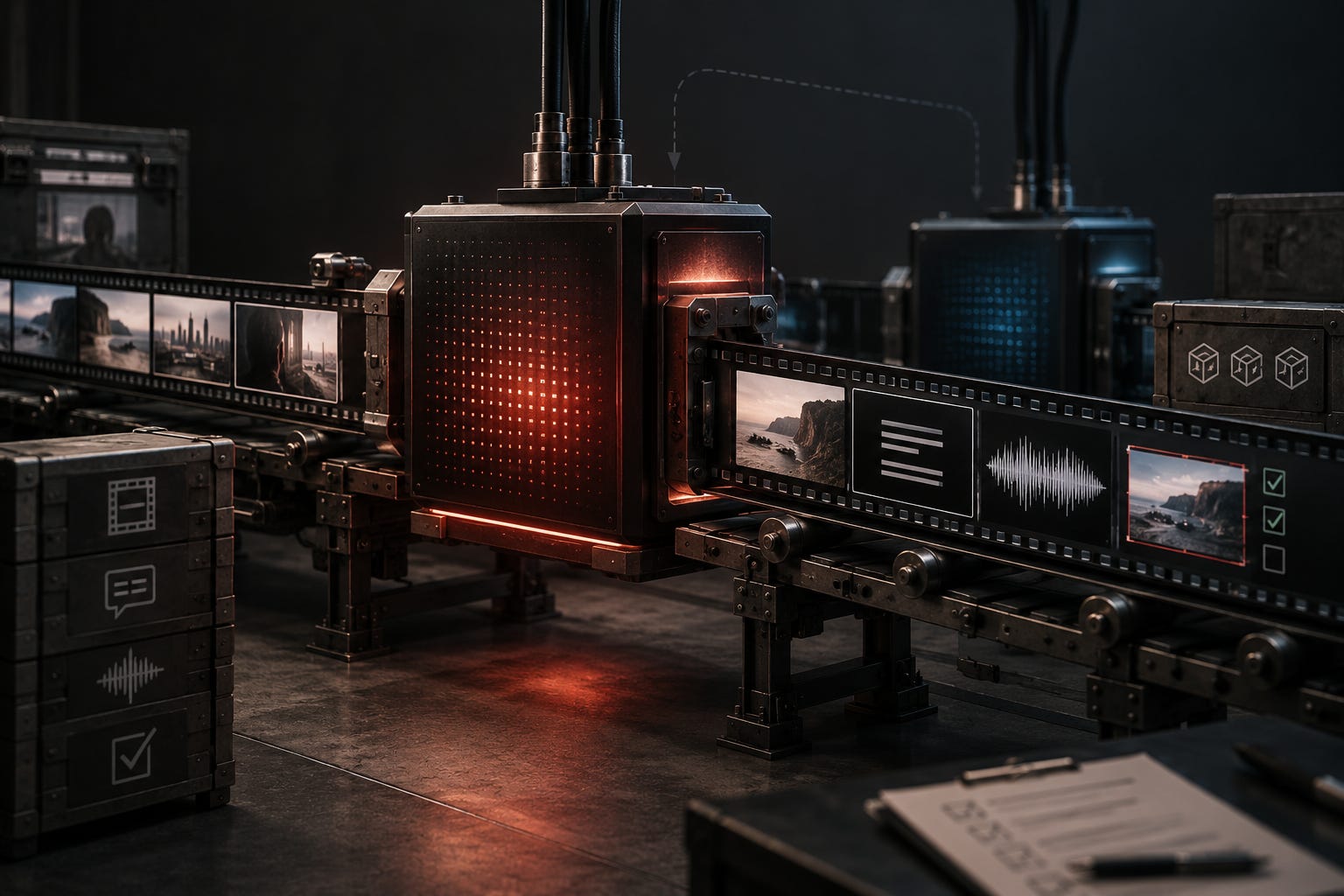
The contract with the model maker gives you data-use terms and a conditional indemnity, and not much else. What it does not give you is a specification. A model is probabilistic: it produces variation by design, it can be wrong, it often is, and the terms say so. That part is not unusual. A resistor comes with a tolerance band, and a localization vendor quotes a QC pass rate rather than a guarantee. Both of those suppliers tell you the shape of the variation you are buying, and you plan the operation around it. Acceptance sampling exists for exactly that reason. The model vendor ships you the variation and no numbers to go with it.
Because you cannot contract for the control, you have to build it.
What you build instead
You build the same five things every mastering and localization vendor already gets before it touches your work. The difference is who produces them. A normal vendor gives you the service level and sends you the change notice; with this supplier you measure the level and detect the change yourself. Your supply chain people know how to do all five.
First, an acceptance criterion, written against real work and not a demo. Second, a tolerance stated as a rate on a reference set, which is the same method I use to set service levels in media supply chains, taken off a measured baseline instead of declared. Third, change detection, so a new version gets scored before you cut over to it. Fourth, a qualified alternate you keep current and feed work to periodically to keep it up and tested. And fifth, a process owner, because audit, review, respond, and fix only happens if it is somebody’s job.
Models are commoditizing in price, not in behavior, and the qualified alternate is the item that gets skipped. Technicolor showed what that costs from the vendor side: a supplier with more than a hundred and ten years of history was very suddenly liquidated in early 2025. The companies with a qualified alternate were better able to manage than those that had to rapidly figure out what to do next.
Not one of those five requires the vendor to agree to anything.
Where the failure lands
Say none of this gets done. There is no acceptance criterion, no measured tolerance, and no qualified alternate. This is what that looks like in an operation, and why nobody will call it a supplier problem.
Take one dependency chain. A localization workflow tuned over months to one model’s behavior, a QC step that leans on one vendor’s detection, an orchestration layer built against one provider’s API. The model changes, outside your control. Output drifts and the post-editors absorb it by hand until they cannot, the QC step starts passing what it used to catch, and the miss surfaces as late deliveries and rework. The dashboard charges it, correctly, to operations. Unfortunately this is a common issue, the “upstream system that changed its schema on a Friday and broke stuff” problem. What is new is that the party upstream is a foundation model vendor under no obligation to do things differently.
In the performance measurement work I have done for media supply chains, every missed delivery gets assigned a cause: materials, capacity, intake assumptions, downstream queueing, vendor. That assignment is what tells you where to spend money to fix it. The list of causes is set in advance, and none of the lists I have seen has a line for a supplier changing its own product. So the miss gets recorded against capacity, and the next quarter somebody funds more capacity to solve a problem that was never about capacity.
Until somebody adds the model to the list of things that can go wrong, its misses get charged to operations.
None of this requires new technology or a new function. It requires calling the model a supplier and handing it to the people who already manage suppliers. Almost nobody has, and the reasons are more defensible than they look.
Stay tuned this week for Part 2: why nobody owns this supplier, and why the models your vendors are already running on your content are the bigger exposure.
