The Pipe Always Changes First
A pattern as old as Gutenberg. A power grab as new as last week.
danah boyd recently shared a report from MediaJustice on LinkedIn that’s worth the read. Authored by Steven Renderos, it argues that tech companies are capturing the media system through ownership, financial dependency, and control over distribution. Boyd has long examined how infrastructure shapes information flows and power and her upcoming book, Data Are Made, Not Found, sits squarely in that tradition. I can not encourage you enough to go read her work!
The MediaJustice report lands on something important and a topic I have talked about a lot before, that distribution has become the center of gravity. Maybe it feels obvious to say out loud, but distribution technologies evolve faster than the tools used to create the content flowing through them. The new pipes arrive before anyone understands what kinds of stories they’re supposed to carry.
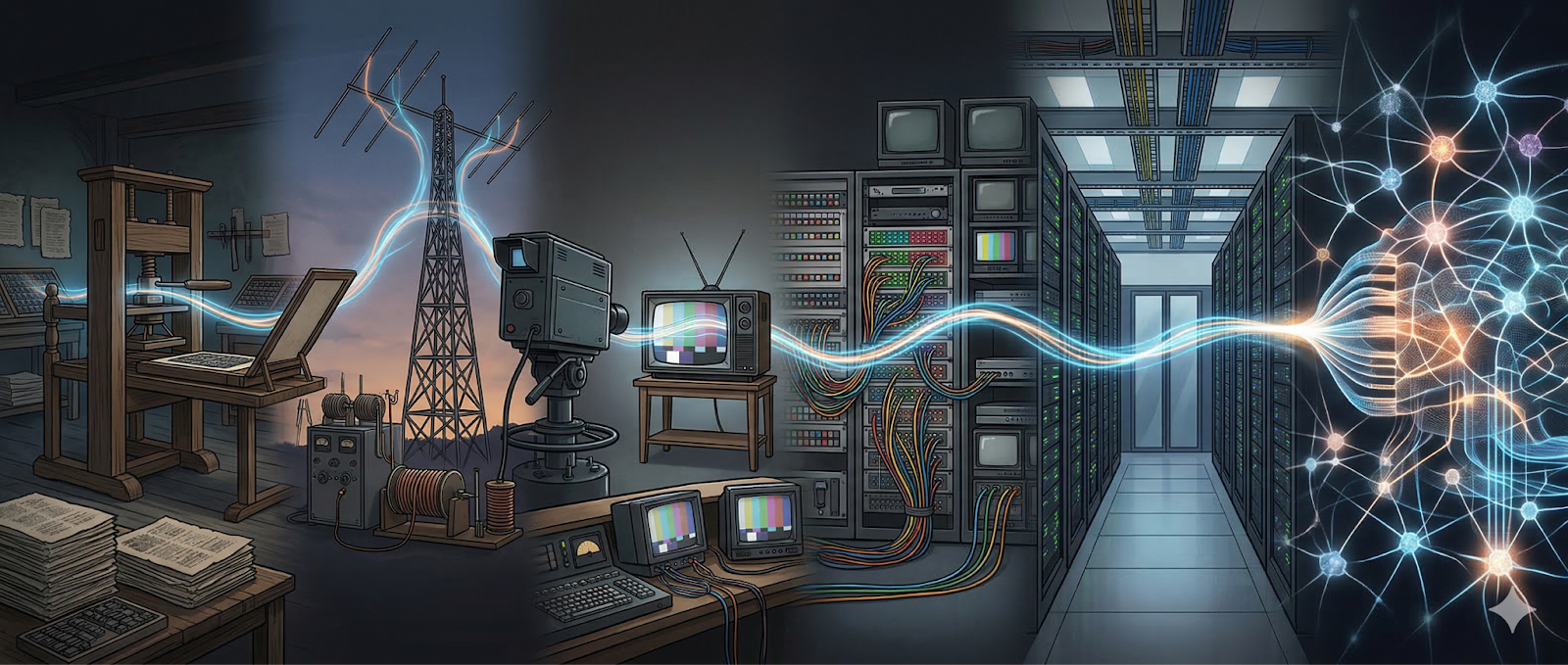
The printing press is the earliest clear example. Gutenberg dramatically expanded the ability to reproduce text, but the first printed works looked like manuscripts. Religious texts, legal documents, and pamphlets dominated for decades. It took generations before formats emerged that exploited the medium on its own terms: newspapers, serialized fiction, mass political pamphleteering. (See Eisenstein’s The Printing Press as an Agent of Change for the definitive account.)
The distribution system expanded first and storytelling evolved later. Radio followed the same trajectory with early broadcasts in the 1920s where only newspapers read aloud over the air. Producers borrowed formats from existing media. Over time radio developed its own grammar of serialized dramas, live sports, and new forms of audio journalism.
Television then repeated the cycle. Early programs resembled filmed radio shows or stage productions. Cameras pointed at performers delivering scripts. The visual grammar that defined the medium (multi-camera sitcoms, broadcast news, episodic pacing) came later.
Cable in the 1980s expanded distribution again. Hundreds of channels appeared where a handful had existed before. The industry didn’t yet have the content to fill them. Entire categories of programming emerged in response from 24-hour news, niche lifestyle channels, and the fragmented ecosystem that defined the cable era.
Each time we see the same sequence. A new distribution technology expands the ability to move media. Content looks familiar at first because creators rely on existing habits. Then the medium develops its own forms, as storytellers learn to work with the new infrastructure.
The pipe changes first. The storytelling catches up. Digital media followed the same arc. The internet effectively created an infinite global distribution. Early web content still resembled what came before. News organizations built digital newspapers. Networks uploaded broadcast clips. Studios experimented with streaming while still thinking in terms of television schedules and seasons. But formats native to the medium arrived later like creator-driven video, live streaming cultures, and algorithm-shaped content evolving inside YouTube, Twitch, and TikTok.
It’s happening again, but the pattern is messier this time. AI isn’t just reshaping distribution. It’s accelerating change across production, post-production, and content creation at the same time. Tools for generating, editing, and adapting media are evolving as quickly as the systems that deliver it.
But distribution will still set the terms. Devices and contexts increasingly determine how long we engage, where we watch, and what form content takes before it even reaches us. Whether production likes it or not, those constraints are set upstream. Algorithms determine which stories appear in feeds. Search engines summarize information before users reach the source. AI systems are reorganizing how information is discovered, recommended, and consumed.
These systems work differently from anything that came before. Broadcast television delivered the same signal to every viewer. Newspapers printed identical editions. Even early web publishing assumed audiences would arrive at a page and see roughly the same thing.
Algorithmic distribution doesn’t work that way. Content gets sorted, ranked, summarized, and personalized before it reaches anyone. Two people can encounter the same story through entirely different pathways: a recommendation feed, a search result, a clipped segment, an AI-generated summary.
The pipe is changing again. Most content is still produced as if it will be consumed inside older distribution models like television schedules, article pages, social feeds, or fixed video timelines.
When distribution changes faster than production, industries reorganize around the new infrastructure. Formats evolve. Storytelling adapts. New institutions emerge. That process takes time and we’re still early in this one.
But this cycle is different in one critical way. The gap between old production and new distribution isn’t just a creative lag. It’s a power vacuum. And it’s being filled deliberately.
That’s where the Renderos report connects. MediaJustice maps how tech companies are consolidating control over distribution through three interlocking strategies: buying media companies outright, creating financial dependency through funding and AI partnerships, and controlling the platforms where most people encounter information. The same companies building data centers and selling surveillance tools are acquiring the outlets and algorithms that determine what counts as news.
This isn’t new in structure. In every previous transition, whoever controlled the new distribution infrastructure captured disproportionate value while production caught up. Gutenberg’s printers held leverage over authors. Broadcast networks held leverage over studios. Cable operators held leverage over channels. Platform companies held leverage over publishers.
You can see the same dynamic playing out now in real time. Deals like the Paramount–Skydance transaction aren’t just about content libraries or studio consolidation. They’re about positioning inside a system where distribution, capital, and infrastructure are increasingly intertwined.
The current transition is following the same logic at a different scale. The companies reshaping distribution aren’t just carriers. They own the pipes, fund the content, train AI on the journalism, and decide through algorithms what reaches whom. Ownership, financial influence, and platform control operate as a single system.
Production will catch up. It always does. But the question isn’t when. It’s who controls the distribution layer in the meantime. When the pipes change, the stories learn how to flow through them. The leverage belongs to whoever owns the pipes while they do.


