

Power With a Physical Address
There is a moment when power stops being a metaphor and starts taking up space. You can hear it in the hum of a hyperscale datacenter at two in the morning, the kind that rises on the edge of a town before local government even understands what is being built. Rows of transformers, cooling towers, fiber trenches dug before anyone asks who owns the switches at the end. You can feel the shift the first time you realize the most important political decisions of the day might be happening inside a building zoned as light industrial.
Or take the night Starlink flickered for Ukrainian forces in the middle of a counteroffensive. That wasn’t a policy debate. It was a single private actor making a decision that altered the course of a war. The kind of power that used to involve treaties and statecraft now lives inside a permissions dashboard.
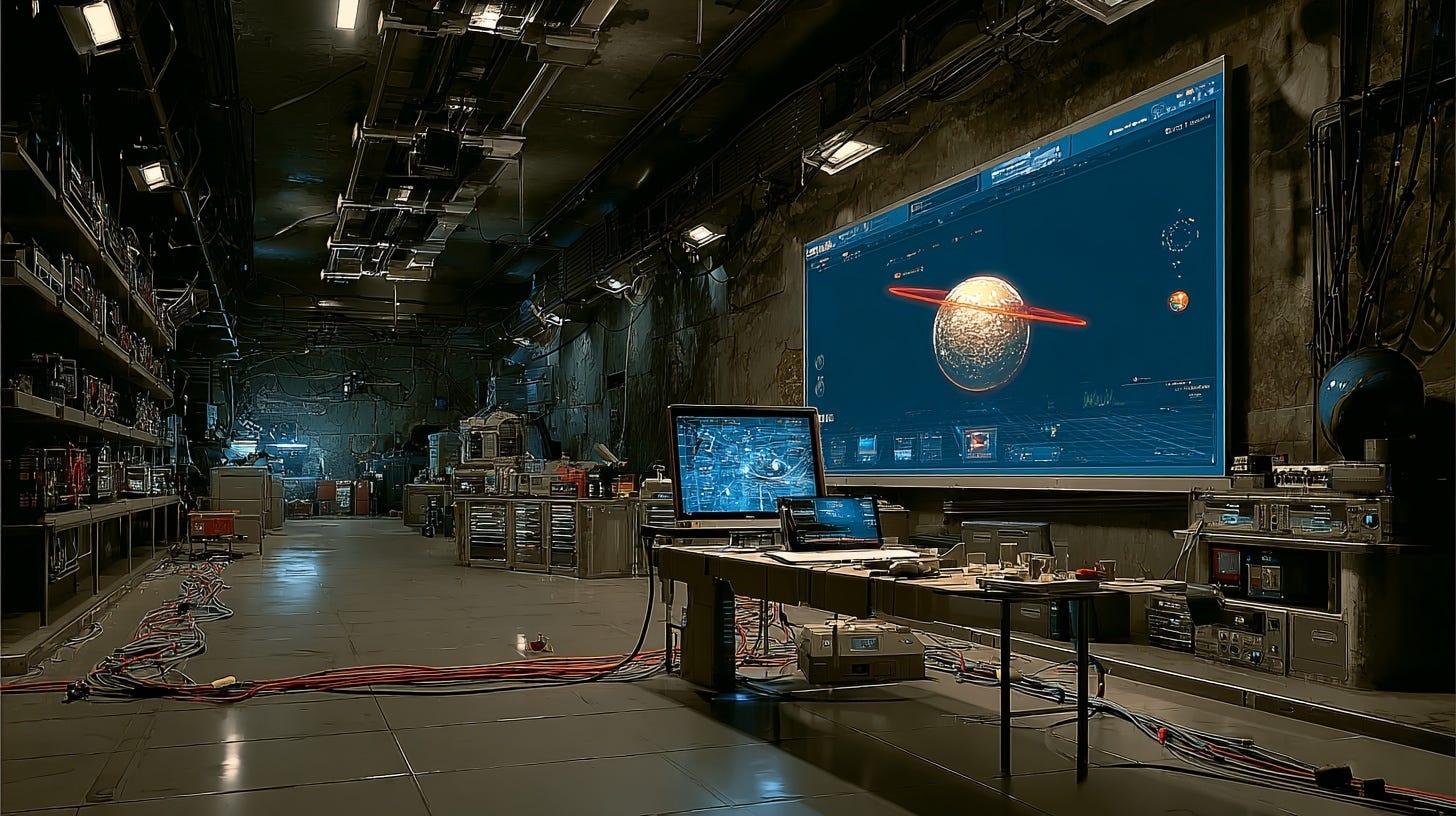
That is the world we are standing in. Power now has a physical address. It is measured in megawatts, coolant flow, satellite coverage, and GPU availability. A sufficiently large GPU cluster can tilt an entire industry. A blackout in a single cloud region can knock a country sideways. The new leverage isn’t persuasion. It is infrastructure.
This is the point where Silverman’s political radicalization stops being theoretical. The belief systems we traced in The Faith Layer have been poured into concrete and steel. Founders aren’t just broadcasting ideology; they are operationalizing it. In their hands, compute becomes a territory with its own borders, incentives, and consequences. A private landscape that sits inside the public one, but obeys a different logic.
Tim Wu’s argument about extraction starts here too. Control the chokepoints and you decide who gets access, who gets delayed, and who gets priced out. In the nineteenth century, it was oil and rail. In the twentieth century, it was telecom fiber and broadcast spectrum. Today it is GPU clusters, satellite networks, and the interconnects that bind them together. Compute is the newest chokepoint, and the people who own it wield a kind of authority that has outpaced the institutions meant to govern it.
We pretend this is still about innovation. What it really looks like is jurisdiction.
