

My earlier piece, The Canon Problem, asked how a decision inside a story world comes to count. Not whether it happened, and not whether anyone wrote it down, but whether the next writer has to work around it. Think of that as precedence. Precedence constrains what comes after it. A thing without precedence is just something that occurred. That essay left an open question. Decisions accumulate, and they do not necessarily keep the same weight. What happens to the earlier ones when the later ones arrive?
On April 25, 2014, Lucasfilm changed what its own past was allowed to do. The statement was careful, and it did two things at once that most people read as a single action. It named George Lucas’s six films and The Clone Wars as the immovable objects to which all other tales must align, and it said that everything else, thirty-five years of novels and comics and games written to be consistent with each other and with the films, would no longer bind. The stated reasons were creative freedom for the sequel films and the preservation of surprise. Lucas, the statement said, had never been beholden to that material anyway. Then, in the same breath, it said the material was not being discarded. It would stay in print under a new banner, and the creators of new Star Wars would have full access to it.
So the record survived intact and lost its authority in a single act. Nothing was burned. Every fact about Thrawn and Mara Jade and the Yuuzhan Vong remained exactly where it had been the day before, available to anyone, and none of it could tell a new writer what was true. Having a history and being governed by it turned out to be two different conditions, and Lucasfilm had just pulled them apart in public, at a scale nobody could miss. Who had the right to make that call has an answer, and it is the boring one. The company that owns Star Wars, acting through the people running it. Thirty-five years of decisions were still sitting there, readable, ignorable, and available. What does a later decision-maker do with a body of work like that?
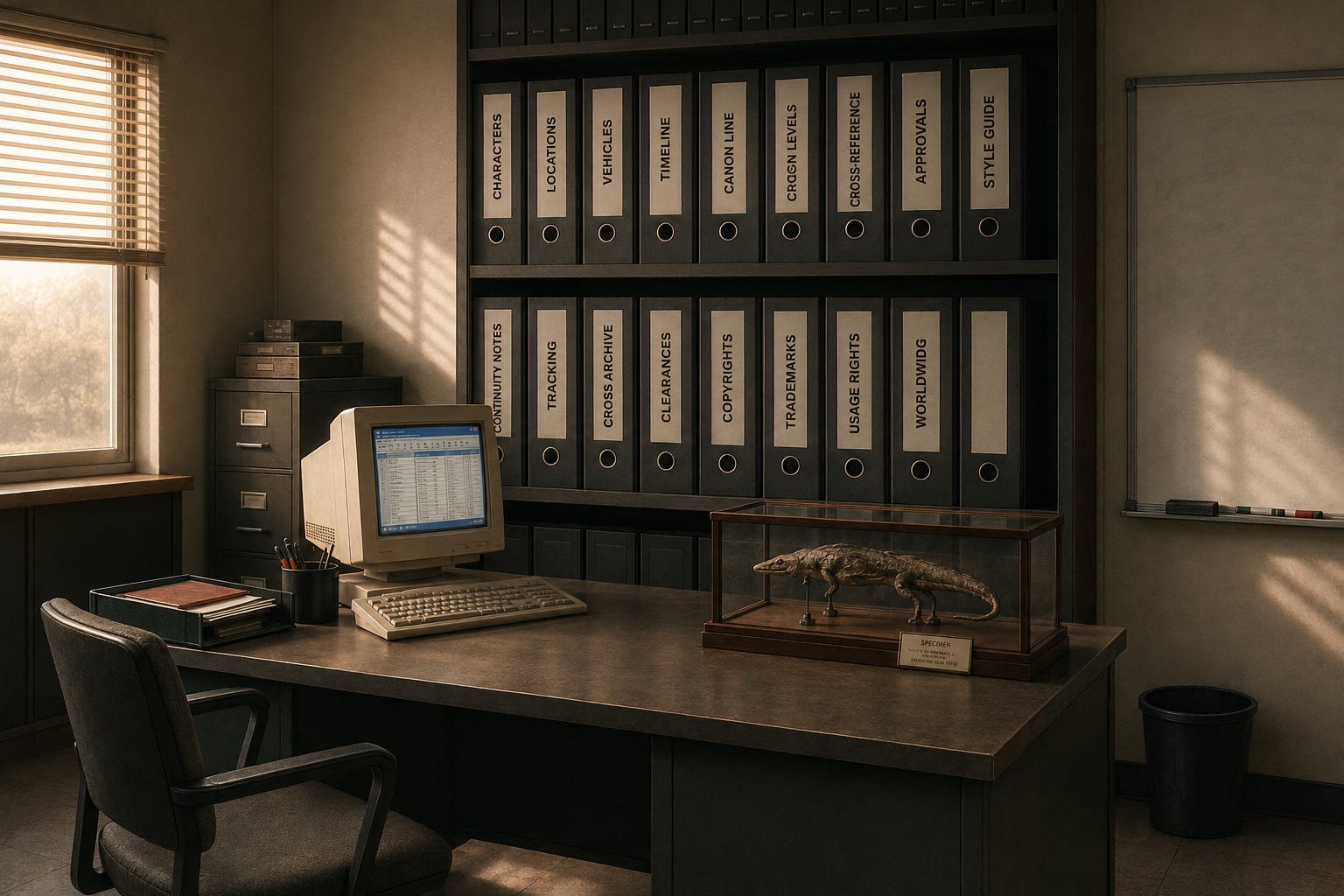
Start with the record everyone thinks they know. Lucasfilm kept a continuity database called the Holocron, and for years it was described, by fans and by the press, as the closest thing a story world had to a court, the place where canon was adjudicated, where every ship and planet and character was filed at a level of authority, where the franchise remembered what it had ruled. Its keeper was a man named Leland Chee, and Chee spent a good part of two decades explaining, patiently and on the record, what it actually was.
Believe it or not, the Holocron was a FileMaker database, and it worked. Built inside Lucas Licensing in early 2000, it grew to tens of thousands of entries covering characters, planets, vehicles, weapons, and organizations, and new additions were checked against it while Licensing enforced consistency through it in practical ways. It carried a top-level category for material originating with Lucas himself, which is authority represented in a field. But Chee’s own account is narrower than that reputation. He said the database’s job was to track continuity for Lucas Licensing and, to some degree, the company’s online arm, and that to his knowledge it was only rarely used for production. The famous canon levels, the tiers fans argued about for years, were a construct built for the database, and Chee said most of the people using it skipped that field and went to the source material instead. Lucas had never given directives about how anything was entered. Chee had no direct contact with him about continuity at all, and what he saw were notes from other people’s meetings. And in 2005, asked on the StarWars.com forums where the real canon lived, Chee described a version in George’s head at any given moment that nobody else knew, and said it was constantly changing.
That is a more interesting instrument than either the reputation or the debunking suggests. The Holocron could tell you where a thing sat in the pecking order. It could not tell you why it sat there. Those are different kinds of information, and the difference matters more than it sounds. A database field can hold a rank, this is top-tier, that is second-tier, and so on. What it cannot hold is the argument that puts it there. And the argument is exactly what a later decision-maker needs, because ranks only help when things disagree, and two entries at the same rank that contradict each other leave you with nothing to go on. That gap stayed invisible for as long as it did because the people who needed the argument could go find the person who had it.
Which leaves the question I am trying to address here. The record could say what ranked above what. It could not say why, and the why is what lets a past decision guide a future one rather than just sit there being true. So where was it kept? Anyone who has inherited a body of prior decisions knows the shape of that problem without needing the vocabulary. Tom Brevoort, who has edited at Marvel since 1989 and took over the X-Men line in 2023 at the end of a five-year era, was asked in his newsletter whether inheriting the X-Men’s continuity was a gift or a burden. He said it was always a little of both, that there are always stories he wishes had gone differently, and that past a certain point you accept that they happened and play the ball where it lies. Play, not leave. The prior decisions are on the field and you work from where they landed. Which opens the harder version of the question. What does it mean to play the ball where it lies when the ball came from a continuity that has been declared not to bind?
Lucasfilm answered that in public in July 2016.
At Star Wars Celebration in London, Dave Filoni announced that Grand Admiral Thrawn was coming to Rebels. Thrawn was the villain of Timothy Zahn’s Heir to the Empire, published in 1991, the book that effectively launched the modern Expanded Universe, and he had been Legends since the reset. Filoni and Kiri Hart, Lucasfilm’s head of development, had pitched the return, and reporting from the panel says the idea had been under consideration for some time. Zahn was writing a new canon novel about the character. A major figure was being lifted out of the record that did not bind and given standing once again.
Then Filoni distinguished the addition. Zahn’s novels had come with a specific piece of hardware attached to the character. The ysalamiri were lizard-like creatures that generated a bubble in which the Force did not function, and Thrawn used them to strip Jedi of their advantage, which is how an ordinary military officer with no Force sensitivity stayed credible as the antagonist of a Star Wars story. Take the creatures out and the problem of how Thrawn survives contact with a Jedi has to be solved some other way. Fans at the panel understood exactly what was at stake and asked whether the ysalamiri were coming too. Filoni said no, and gave the reason. Years earlier, during The Clone Wars, he had discussed the creatures with Lucas, and they had concluded that a living thing removed from the Force contradicted Lucas’s conception of what the Force was. Zahn later acknowledged that the ysalamiri had been one of the few notes Lucas ever gave him on the original books. Asked about Mara Jade, Zahn’s other great creation, Filoni said not likely.
Look at what that ruling required. Thrawn and the ysalamiri came from the same books and, after 2014, carried the same claim on the new canon, which was none unless Lucasfilm chose to restore it. A later authority went back into that body and did not treat the package as indivisible. It took the character and refused the device, and the ground for the refusal was a rationale that predated the ruling by years. That last part is where a skeptical reader will push, and it is worth being exact. Lucas’s conception of the Force was not merely an older creator’s opinion. It carried higher standing inside the canon regime Lucasfilm itself had reaffirmed two years earlier, when it named his films and his television series as the objects everything else must align to. Filoni was applying a principle that still governed the question, and the record of why the ysalamiri were excluded is that principle, remembered from a conversation and stated in public.
Lawyers have a word for what Filoni did there. When a judge is handed an old case that looks like it ought to decide the matter in front of them, and the judge explains why it does not apply here, or why part of it applies and part of it does not, that move is called distinguishing. The old case is not overturned. It stays on the books, still good law for everyone else. It simply stops reaching this particular set of facts. Courts can do this reliably because they have machinery built for it, rules about which decisions bind which judges, a habit of writing down reasons, a citation system that lets anyone find those reasons later, and a doctrine governing when an old rule may be set aside. Story worlds have almost none of that. What Lucasfilm had in July 2016 was one person carrying the reasoning that let him tell two things from the same book apart. Yesterday’s rulings become tomorrow’s constraints, and they did here, but notice where the reasons had been kept. Not in the Holocron, but in Filoni’s memory of a conversation with Lucas. Which also means it could have gone the other way, and nothing in the record would have objected.
The people making Rebels then did something quiet with what they had refused. Look at Thrawn’s office in the show and there are sculptures of lizards framing the desk. They are the ysalamiri, present, recognizable, kept. They cannot repel the Force, because in this version of Star Wars no such creature exists. So the show is doing two things with one prop. It is acknowledging where Thrawn came from, and for the part of the audience that knows the books, it is displaying the exact piece of that inheritance the new canon refused. The creature is in the frame. It has no power over anything. Cited without authority, preserved without standing.
So that is one company’s answer to what a later decision-maker does with a body of work that no longer binds. Lucasfilm goes back in and picks, restoring one piece at a time and leaving the rest where it lies. The obvious next question is whether anyone else works this way, and the short answer is that the other places worth looking have each landed somewhere different.
