


Skydance now owns the biggest film and TV library in Hollywood. Everyone is arguing about what it’s worth. Almost no one is asking whether the company can say yes when an AI company wants to use those films.
Right now it can’t, at least not title by title. The old contracts never imagined these uses, and nobody has written down who gets a say. Whoever builds that record, and gets buyers to trust it, holds the next point of control in this business.
The argument about worth is a good one, and Evan Shapiro started it. On Monday he put the new Skydance Corporation on his media map as a small red dot worth $29 billion. This month he turned it into an app, an interactive version of the media universe chart he has drawn since 2020 that readers can zoom into, search and run back to 2015. Nearly every planet on it is sized live from its market capitalization. Skydance is the exception, sized by hand. In the post introducing the map, he calls his figure a net asset value of his own construction, discounted for what he names the Ellison Risk. The map draws that risk as a dashed line tethering Skydance to Oracle, since both lean on the same family’s balance sheet and credit markets have started treating them as one bet.
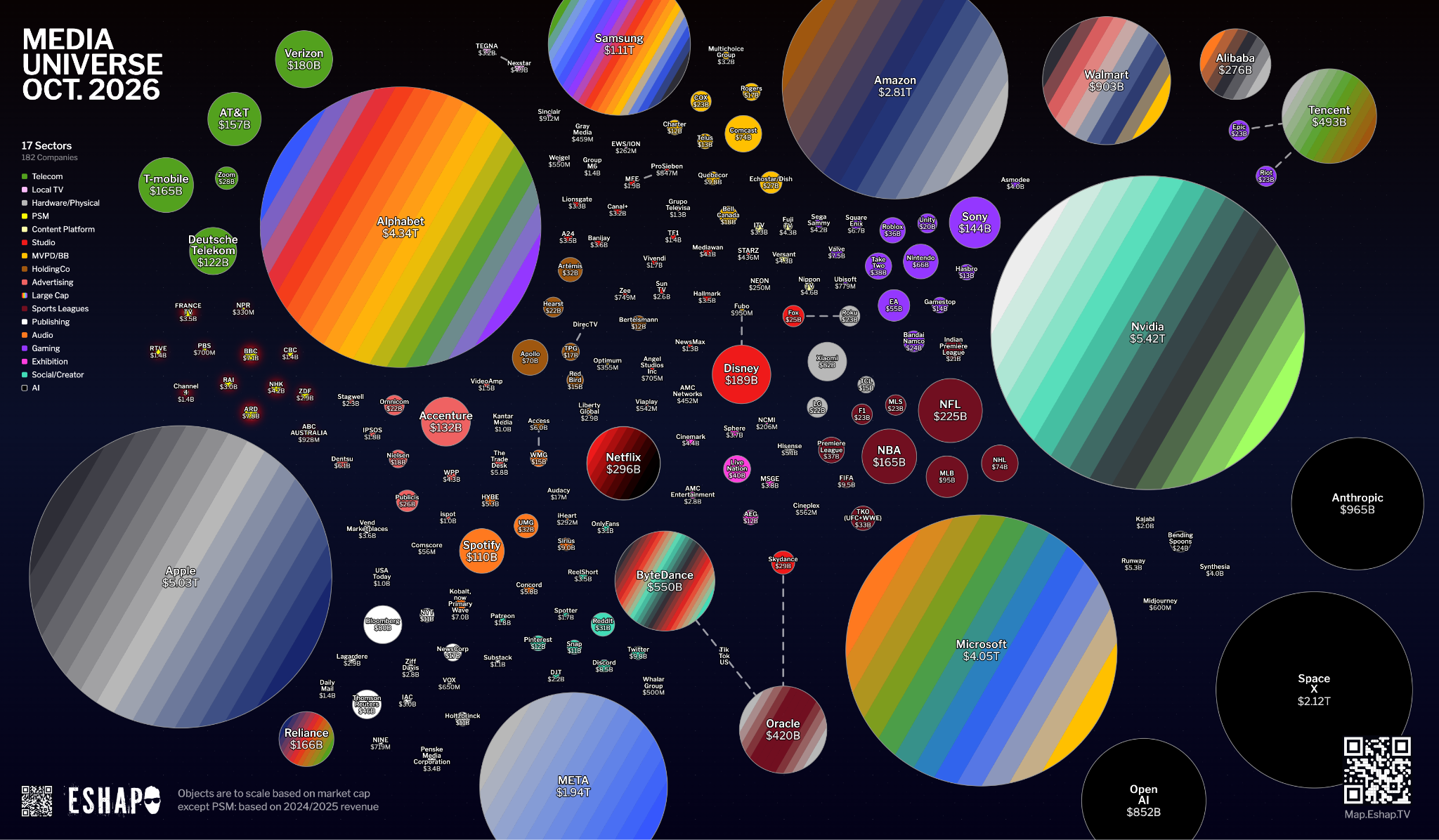
The tether is fair, and how steep that discount should be is a fight for people with better spreadsheets than mine. The market’s version, which prices the equity alone at about $46 billion before any debt is added, lands a long way from his. I’m not going to referee it, because for this essay the distance between the numbers matters less than what they share.
Both numbers price the library as something to distribute. Neither prices whether it can say yes. Skydance can license a great deal of what it owns, the way studios always have. What it cannot yet do, title by title, is say which of its films may be licensed for a use nobody wrote into the original contracts, in which territory, with whose consent. The pressure arriving now concerns what the library is permitted to become, and the problem is less what any one contract says than answering for all of them at once.
The Old Switch
As I’ve said before when writing about this deal, Tim Wu’s The Master Switch is the history I keep returning to. Its organizing claim is that every American information industry eventually closes around a single point of control. The telephone had AT&T’s network. Film had the studio that owned production, distribution and the theaters, which is the history I walked through last month when the Paramount consent decree came back with its conduct half and without its structural one. Wu called the movement from open to closed the Cycle, and by any measure Skydance is the most complete closed phase Hollywood has ever assembled. Two studios, two streaming services, broadcast and cable networks, and a library that Warner Bros. alone counts at more than 12,500 features.

The temptation is to read the merger as the Cycle arriving where it always arrives. The balance sheet suggests a stranger reading. Fitch puts the gross debt near $87.5 billion and finds that 86 percent of last year’s pro forma earnings came from linear television, a declining business, and the part of the switch shrinking fastest, and it expects that getting leverage to target by 2029 will take equity issuance or asset sales. Renting the library to everyone else is shrinking too. Warner’s third-party content revenue fell from $11.2 billion to $9.6 billion between 2023 and 2025, and the merger will shrink that line further by pulling the decade’s biggest library deals, Friends and South Park among them, back inside the house.
Wu’s moguls bought control of the channel when the channel was the future. Skydance borrowed heavily to buy it at the moment the next valuable use of the library stopped running through the channel at all, and the consolidation is as much a reaction to that decline as a show of strength. What it leaves behind is the largest archive in Hollywood, owned by a company that cannot yet say what it is allowed to do with it, and a new switch forming somewhere outside the deal. Where that switch went, which incumbents are already moving to swallow it, and who might end up holding it are what the rest of this piece is about. Skydance has every reason to want the answer to be itself. Nothing on the record yet says it will be.


