When AI Stops Watching
Media over QUIC could turn AI from an observer of the video pipeline into a publisher inside it
Almost every plan for AI in media operations that I have seen makes the same assumption without stating it. The AI sits more or less outside the pipeline. It taps the stream, does its analysis somewhere else, and writes its output into an adjacent system that somebody then reconciles with the media it describes. The model can watch. It cannot participate.
That assumption is starting to expire, and one of the moments that convinced me came at the Portland Video Tech Meetup this June. Oracle’s Gaurab R. Upadhaya, Matthew Young, and Ai Lou demoed a live soccer feed with an AI analyzer subscribed to the video like any other viewer. The analyzer watched the match frame by frame, detected goals, clipped replays, and published its findings back into the same session as an event track. Every subscriber received the goal events through the same publication-and-subscription architecture carrying the video. The machine held a subscription and a publication in the same session.
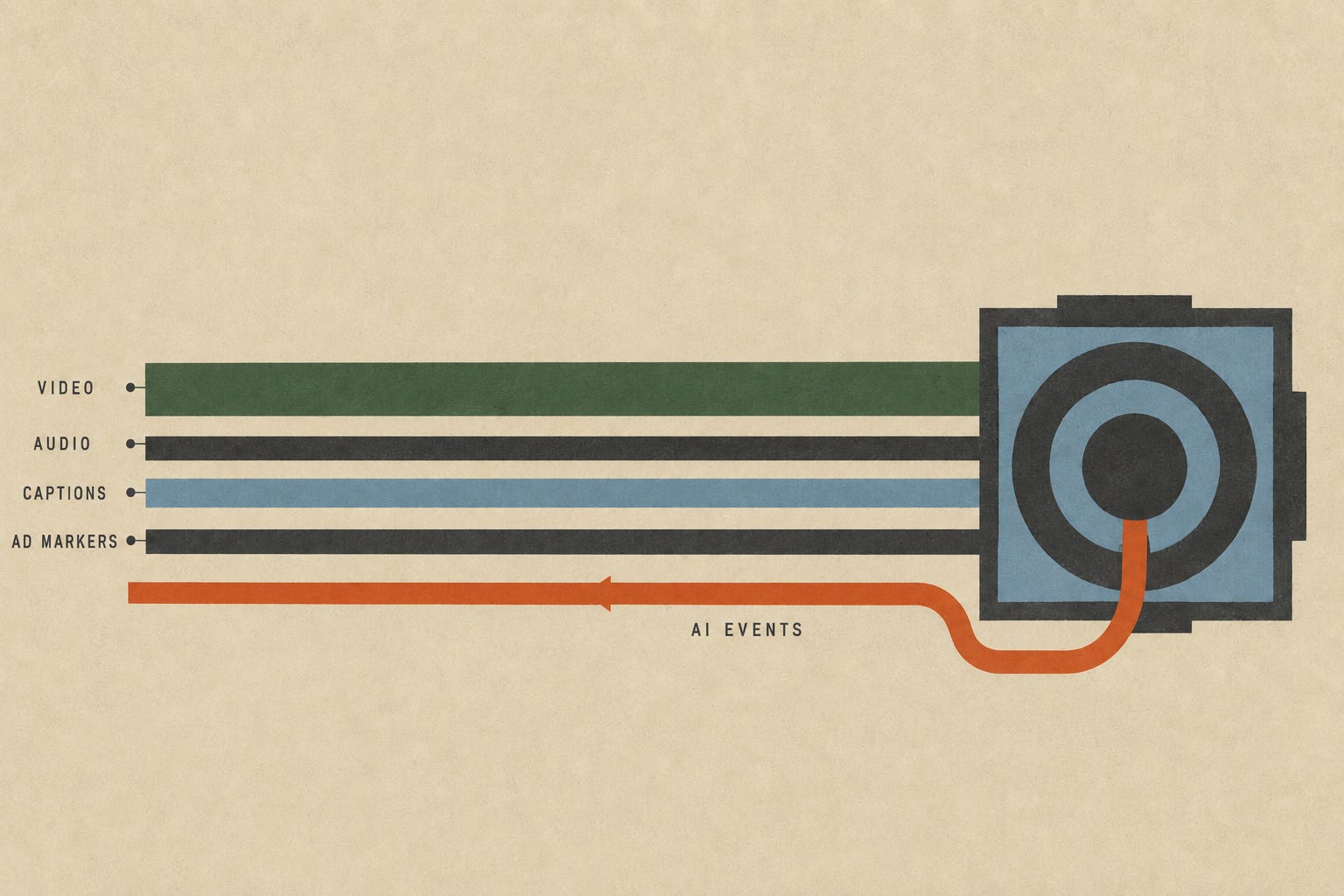
The obvious objection is that none of this is new. Machines have been writing ad markers, captions, QC events, and metadata for years. The problem was never generating the signals. It was everything that happened after. Each one rode its own transport, its own translation layer, its own synchronization logic, and its own integration into every downstream system that needed to see it. This demo showed a different pattern. The events didn’t live beside the media anymore. They traveled with it as first-class objects on the same transport, available to anything downstream without another custom bridge built just for that signal. That’s the story. The protocol underneath it is the supporting cast.
Why the machine was ever outside
The protocol is Media over QUIC, or MoQ, and most of the industry has filed it away under low latency. And latency is a real benefit here; in their presentation, the Oracle team reported time to first frame eleven times faster than HLS at the median. But latency is the pitch that gets the protocol into the room, and the consequential change is architectural.
Today’s streaming systems are two systems wearing one name. One set of protocols moves media from cameras and encoders into the plant (you will often hear this called the contribution path). A different set, built later by different people to solve different problems, moves it out to viewers (or the distribution path). Between them sits the packager, translating one world into the other. That translation point has existed for so long that it now reads as permanent geography rather than as a decision we made collectively.
The video always survives the translation, which keeps the cost invisible. What potentially dies is everything else. Captions, ad markers, timing cues, provenance signing. Each survives only by explicit arrangement, and anything without a configured mapping vanishes. Barry Owen of Wowza, who has spent much of the last year documenting streaming metadata alongside Rebecca Avery and others, put the default behavior in one sentence during his own talk that same night. “The video plays fine. You just lost everything that made it intelligent.”
That sentence explains more about the state of AI in media than most strategy decks. The pipeline was built to move pictures and treats everything else as freight. An intelligence layer cannot participate in a system that structurally discards the data it requires. So the machines were parked outside, and this too became one of our immutable design laws.
MoQ loosens the constraint with two moves. It can carry the stream on one protocol from contribution through distribution, which removes the translation step that exists purely to switch protocols. Transcoding, packaging for devices, DRM, and ad insertion all remain. What can disappear, inside the portion of the pipeline running MoQ, is the protocol seam at which every non-video signal has to be translated by explicit arrangement. The second move is the one that matters for machines. MoQ generalizes publishing. Video, audio, captions, ad signals, and event data can each be published as independently subscribable tracks. The relays that fan the stream out to viewers forward each track without needing to understand what is inside it, and a catalog track serves as the table of contents, telling every subscriber what the session offers.
A new signal type might stop requiring a bespoke transport mapping at every hop. It still needs a shared name and enough application agreement for the receiver to know what that name means. Together those two moves give a machine the same publish-and-subscribe fabric as the media itself, without requiring a separate transport for every new kind of output. What is unusual is not bidirectionality by itself. It is that the same relay architecture can carry the machine’s contribution from the controlled middle of the pipeline toward distribution scale. The team presenting was explicit about how they saw this being used. Third parties build the intelligence, while they offer the metadata track as the backbone for machine participants.
Provenance rides along
The same architecture matters for a problem this publication has spent the summer on. C2PA hard bindings depend on the integrity of the signed asset, which means transcoding and repackaging require the provenance chain to be renewed rather than merely carried forward.
Infrastructure also needs an explicit way to preserve and expose the manifests instead of treating them as disposable metadata. Qualabs, working with EZDRM, Ateme, and Cloudflare, has demonstrated live CMAF segments being signed inside an MoQ workflow and verified during playback. The implementation does not make provenance magically survive transformation. It shows that signing, delivery, and verification can operate continuously inside the live path rather than being bolted onto a finished file afterward.
To be clear, MoQ was not designed explicitly for machine viewers. But the ecosystem for IP contribution and IP delivery is maturing into a single fabric at the exact moment the industry is deciding what besides humans will need to consume it. A generation of transport decisions and a generation of AI decisions are landing in the same budget cycles. An operator who resolves the first with only human viewers in mind will realistically have to resolve it again.
What is real
The MoQ spec currently sits at draft 19, dated July 6, with no working group last call and a milestone to request publication in December. It is moving fast enough that the presenters admitted they sometimes cannot say what has been standardized, and their own writeup is careful to call the transport an enabling mechanism rather than a complete solution. Cloudflare says it has deployed MoQ relays across more than 330 cities on its global network. Oracle demoed multi-vendor interop at NAB in April with Ateme, Broadpeak, Cloudflare, and Bitmovin, and Safari shipped WebTransport in March, closing the last major browser gap. Nobody yet runs MoQ end to end in production to my knowledge (I can’t wait to be corrected on this). Early deployments use it inside controlled portions of the pipeline and translate back to today’s formats before content reaches consumer devices. The pattern shows up on the vendor side too. swXtch.io’s AI Router, which already treats live video as something to route to multiple models in parallel with broadcast timing intact, will get its public debut around IBC in September, and the team has evaluated MoQ while holding implementation until customer demand shapes the build.
The adoption path probably runs opposite to instinct. Televisions ship today with the underlying browser support stripped out, and living room devices survive a decade, so the last mile moves slowest. The Oracle architect, a network engineer for twenty years before he touched video, predicts MoQ lands first on contribution and mezzanine feeds, where one operator controls both endpoints and the efficiency pays immediately. Which would mean the fabric gets built from the middle outward, and the machine-participant architecture will exist in the core of these systems years before a consumer screen touches the protocol. The AI does not have to wait for your television.
The standards and the devices set the technical boundary, but they rarely set the operating pace. The SMPTE ST 2110 transition taught this lesson once. Moving the video plant to IP required new orchestration, monitoring, security practices, and skills across teams that had spent careers working in SDI. What looked like a transport migration repeatedly became a people problem wearing a technology costume. MoQ erases a seam in the architecture that contribution teams and distribution teams have spent fifteen years defining themselves against, with separate vendors, separate budgets, and separate on-call rotations. Remove the seam and in theory someone owns the whole pipe, and decides which machines may publish into it, under whose authority, with what record. In other words, the protocol could grant AI models and agents a seat in the stream. Deciding what it is allowed to say once it sits down belongs to operators, and that debate is moving as fast as the spec itself.


