

My father spent his career as a radio signal engineer for one of the major freight railroads. Among the systems he built were the trackside detectors that watch trains go by, instruments that read a passing train for overheating bearings, dragging equipment, cars missing or out of order, anything that says a train is about to become a problem. The network ran on microwave links and copper, engineered across decades, and it existed for one purpose: to catch the failure before the derailment. He retired in the early 2000s.
Several years later, the railroad called him back. Not to run the old network. To help kill it. The microwave and copper era was giving way to cellular, and the railroad needed someone to teach a new generation of engineers how to decommission systems they had never seen built. Which order to cut. What each piece protected. What could be turned off before what, without leaving a stretch of track blind. What began as a consultation became years of contract work. The organization that had absorbed his retirement without a ripple discovered, a decade on, that it could not safely take his own work apart without him.
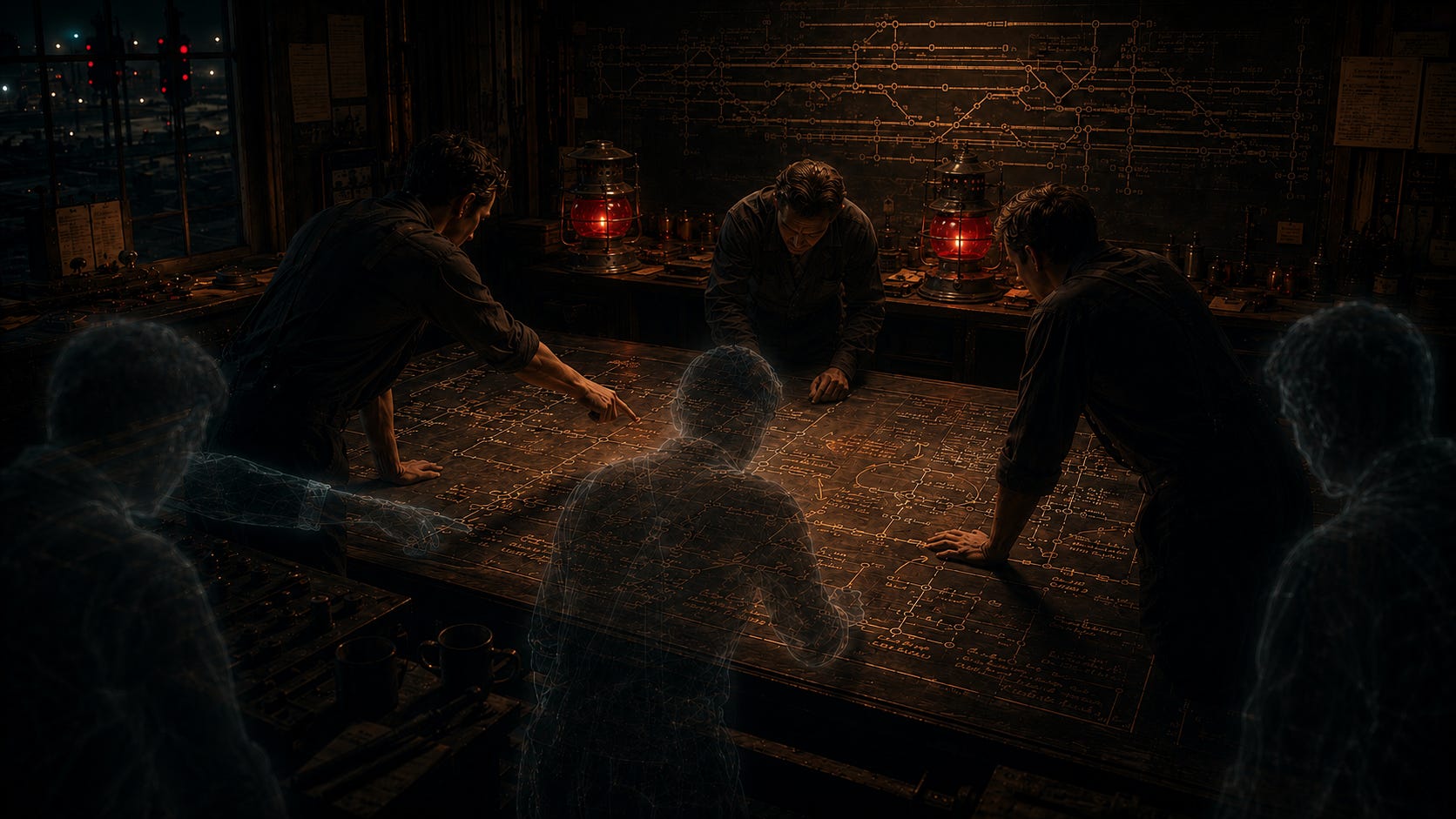
In theory, none of this should have been necessary. Railroads document. This is an industry whose documentation standards most media companies would envy: standards bodies, schematics, signal maintainer manuals, standard operating procedures, rulebooks with revision histories older than television. All the paper existed. The paper was not enough. They needed a human being.
The first two pieces in this series were about what happens to the things, the assets that survive on disk and go functionally dark, and the systems that cannot be removed because everything stands on them. This one is about what happens to the knowing, which was never in the things at all.
The paper and the person
Stay trackside, because the gap has a precise location. The schematics showed every circuit in the detection network. Nowhere did they say which order was safe to cut. Nowhere did they explain why one site was wired against the standard, or which readings the old hands had learned to distrust, or which workaround was protecting which failure. The paper told you what was true. The person told you when to trust it.
That is the split this piece is about, and every industry runs on it. Media’s version is familiar to anyone who has ever reached into an archive: the master that is technically present and practically wrong, the clause that appears in every contract for a reason nobody wrote down, the naming convention that encodes a workflow three reorganizations dead. Call the first kind stored knowledge and the second kind held knowledge. Stored knowledge is the record. Held knowledge is the judgment about the record, and decision history exists everywhere as workflow exhaust and nowhere as durable provenance. The record is flat. The judgment about it never made it in.
