Welcome to the Estuary
Where creators and studios meet, and the money is made somewhere else.

Brian Brushwood has been making shows online for nearly two decades, and this week he told me he has stopped trying to make a living from the shows alone. "I have totally abandoned the idea of making a living just making content," he said. He expects to lose his Shorts revenue under YouTube rules that start February 1, and he plans to keep posting one every day anyway.
His videos now exist to sell something else, and I think that is where a lot of this business has ended up. Creators and studios are both making shows whose payoff lands, at least in part, outside the show. What separates them is who controls the place where the money lands, and who covers the cost of getting there.
Flat water
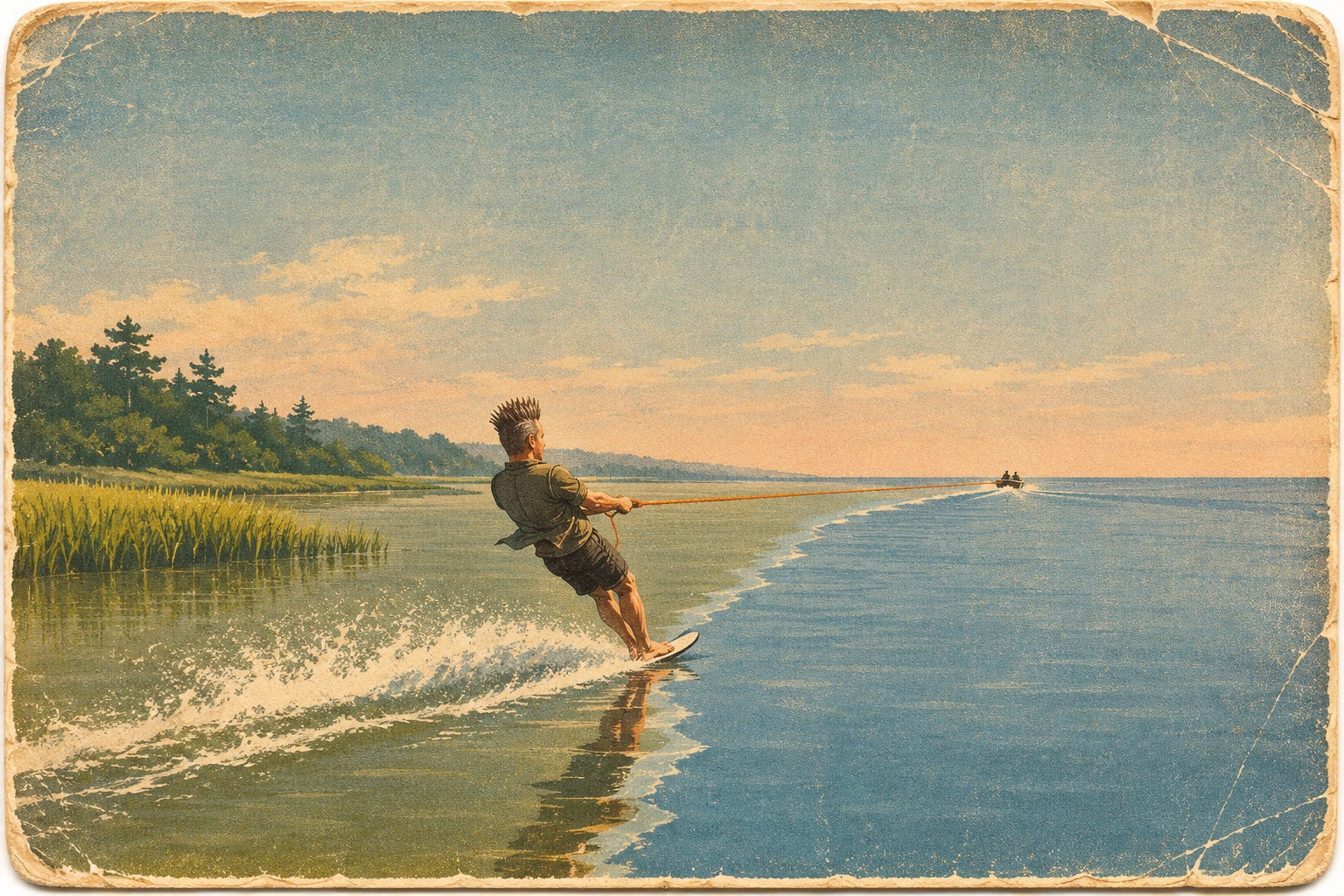
I called Brian because I had been using the word estuary for the place where creator video and studio video now mix. He grew up learning to barefoot water ski on the tidal stretch of the San Bernard River south of Houston, and he liked the word more than I expected. An estuary, he told me, gives you long runs of perfectly flat water that you can't get on a flowing river or out in the ocean. There are things you can do there that you can't do anywhere else.
He also gave me the downside. In marketing, he said, an estuary is the "mushy middle," which is the worst place an idea can sit because nobody can say what the thing is. His read is that the winners here are already playing and nobody has picked them out yet.
What Brian sells
By Brian's count there was one stretch when the content paid for itself, from about March 2020 to the fall of 2022. People were stuck at home and advertisers were paying top dollar. Since then, he said, every piece he puts out has to serve something that solves a problem and makes money. For him that means keynotes and workshops on how AI is being used to run scams.
The videos had to change to fit. He told me a channel built on low-budget MythBusters stunts in his backyard did not sit well next to a man on a stage explaining how robots are defrauding people of billions of dollars. So the channel moved toward the stage.
That is why the YouTube change does not rattle him. From February 1 a channel needs 10 million qualified Shorts views in a rolling 90 days to share in the ad and subscription revenue from Shorts. Channels below that line stay in the partner program, keep earning on long videos, and get Shorts revenue back if they cross it again. YouTube forecasts that it will pay creators more in 2027 than it did this year.
Brian called it "a clarifying move." He told me anyone playing for AdSense revenue is doing it wrong. What he wants from YouTube is attention he can spend somewhere else. "It's the Amazon rainforest out there," he said, "and calories of attention are raining from the sky." He values the room he takes up in a viewer's head above the pennies YouTube pays for the view, and he said he would keep posting if the payments stopped.
It helps to remember how the two sides usually pay. A studio that commissions a show generally commits the money before anyone has watched it. YouTube's partner program pays a share of the revenue after the audience shows up, so much of what gets made there is made on spec, even when a sponsor or a membership softens the risk. Brian has priced that in. YouTube can change what it pays him for a video, but it doesn't set his fee for a keynote.
Brian can afford that view, and he knows it. Later in the call he said he can't tell how much of his approach is sound and how much is the privileged perspective of a 51-year-old Brian Brushwood. He has an audience and a speaking business to point it at, and a creator starting from scratch may have neither. YouTube's post says creators who already earn significant Shorts revenue are unlikely to be affected.
None of this is new, and I should say so. When I signed with Peachpit in 2007 to write Real World Video Compression, a photography professor I knew at the School of Visual Arts pulled me aside. She told me I would hate the process and probably lose money on it, and that the speaking gigs and jobs that followed would make it worth doing. I would argue that book is why I was hired, and why I advanced, in the video encoding world. Studios have sold toys and theme park tickets off their films for generations, and they have worked with independent talent for just as long. What has changed is the size of the audiences creators now build on their own, and the bargaining power that gives them. It has also become harder to see how the value of any one show gets divided.
One show, two outcomes
Beast Games is the clearest case I know. Amazon paid about $100 million for the first season, according to Bloomberg. Beast Industries spent more than that and lost money on it, and Jimmy Donaldson has said he lost tens of millions of dollars of his own. The Wall Street Journal reported that Amazon made at least $100 million in profit on the same season. That figure comes from unnamed sources.
The same Bloomberg reporting shows where Donaldson's own money is made. It drew on documents sent to potential investors, which covered three quarters of 2024 and estimated the fourth. By those numbers his chocolate company, Feastables, had about $250 million in sales and more than $20 million in profit, while his media business had similar sales and lost almost $80 million. His chief executive, Jeffrey Housenbold, described content and media as "a marketing investment in everything else we do."
Why Donaldson made the show and why it lost money are separate questions. On the first, he told an interviewer that streaming services did not take YouTube creators seriously, and that if his show failed no platform would work with one again. He was buying standing in a new market, for himself and for the creators coming after him. The overruns have a plainer explanation. He has said they spent far too much money on it, and Bloomberg reported that he put them down to management problems, inexperience in production and his decision to double the prize, which grew from $5 million to $10 million.
I think this is the flat water Brian was describing. Amazon got the most-watched unscripted series it has had, and Donaldson got financing, distribution and the proof he wanted. It is hard to picture either of them making that show alone. They shared a production without sharing its economics, and by the reported numbers for that first season only one side came out ahead.
Where the studio's money lands
Studios will tell you where their money lands if you read the earnings material. Last year Disney told investors that its live-action Lilo & Stitch had passed $1 billion at the box office. Disney credited the film with fueling viewing of the 2002 original and related titles on Disney+, which it put at more than 640 million hours. It also said the franchise was on track to be its second-largest in licensed merchandise, and that Stitch had been worked into its parks. One film fed four lines of business, and Disney takes part in the economics of all four.
Brian's view is that a studio's real asset is its name. He told me he no longer cares how something was made and only wants to know who made it. An audience that trusts the name is what a studio carries from one show to the next, the same way Brian's audience carries from a video to a keynote.
He also thinks the studios are stuck in an estuary of their own. They have to tell the creators they sign that nobody else understands them, and they have to serve an audience that mostly wants to trust whoever pressed publish. Those two jobs pull in different directions, and a studio courting YouTube talent is now doing both at once.
What is left when the season ends
When a creator and a studio make something together, the first thing I would ask is which of them holds what is left when the season ends. Disney keeps the character and the catalog, and it collects on the toys and the parks. Brian keeps his name and his calendar. On Beast Games, the same Bloomberg profile reported that Amazon ceded ownership of the show, after other prospective buyers had objected to Donaldson's ownership demands. I have not seen the contract and will not guess at the specific rights. If that reporting holds, Donaldson took the loss and kept the show, and Amazon kept the service it runs on and whatever the first season earned there.
That is the asymmetry underneath all of this. Brian can pass up a revenue stream, Donaldson can absorb an overrun, and Disney can judge a film across several businesses and wait. Each of them can capture value somewhere else even when a show does not pay for itself, and each has the money or the audience to keep going until it does. Someone starting from scratch has to build somewhere for the value to go while also paying for the work that might one day make it valuable. I know a small version of this. I had to write the book before I could know whether the jobs would follow, and I can only see the return looking back. Having a plan for where the money will land is different from having the means to last until it gets there. The ability to subsidize your own work is a competitive advantage.
So the estuary is real, and established creators are working in it at a scale that was not open to them before. The money can land on both banks, and what matters is who holds each one. The creator who holds neither is standing in the same water with much less to hold on to.
Brian teaches all of this in person. Do Your Weird Thing runs January 16 and 17 at Modern Rogue HQ in Austin, with a welcome gathering the Friday night before. He will be joined by Tom Merritt, Andrew Heaton, Justin Robert Young and Riley Blanton. Saturday is an all-day class on telling a better story about what you do and finding the people for it. Sunday is a working session on your own project, capped at 30 people, with a heavy emphasis this year on the new tools independent creators are using. It costs $800 for Saturday or $1,600 for the full weekend, and tickets are refundable through the end of December.
I went to an earlier one, and I loved the morning we all watched Brian launch a Short and read the numbers in real time. Details and tickets are on the workshop page. You can hear Brian every week on Cordkillers, the show he hosts with Tom Merritt, and on World's Greatest Con, his series on the great cons and heists of history.
Discussion about this post